Freeing the College Woods From Their Bamboo Prison
Native trees and shrubs on and around William & Mary’s campus are struggling for survival as invasive plants encroach on local forests
December 6, 2025
By
Tracy Matthew Melton ’85, P ’20
Editor’s note: This follows an earlier article chronicling the author’s efforts to clear invasive species from wooded areas in Williamsburg.
William & Mary’s College Woods are home to a host of trees that seem to defy the laws of nature. A pine tree grows in the shape of a saguaro cactus. An American holly stands straight and limbless to the height of a telephone pole. A black cherry tree arcs toward the Southern sun.
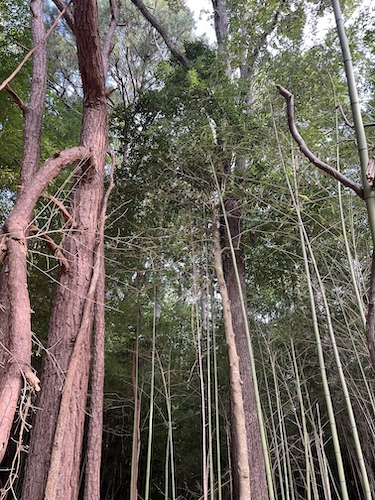
Behind the malformations is a story of survival — a desperate fight for sunlight as invasive plants encroach on Virginia’s forests. Bamboo had captured these trees and forced them to drastically change their shape.
I stumbled upon this woodland drama last December when I was mapping a 5-acre patch of golden bamboo (Phyllostachys aurea) in the College Woods adjacent to Berkeley Middle School. W&M Institute for Integrative Conservation (IIC) students David Fan ’25 and Libby Henrickson ’25 had developed an app to map invasive plant species on campus, and I wanted to document this bamboo patch.
Amplifying the harm was a massive Chinese wisteria (Wisteria sinensis) infestation at the southeast corner of the patch. I discovered the wisteria while walking around the bamboo and entering GPS coordinates into my phone. Wisteria is responsible for killing numerous large trees and other vegetation in the area. Here, it was becoming intertwined with the spreading bamboo.
I’m a Virginia master naturalist and am working with volunteers including Keith Navia ’78, Jeff Honig P ’22, W&M geology professor Linda Morse, fellow master naturalist Jennifer Smith, W&M students and other members of the university community to fully eradicate infestations of invasive species from various sites on and around campus: Crim Dell, across from the William & Mary Alumni House and along Compton Drive.
We received necessary permissions and began removing the wisteria near Berkeley Middle School in January. It is strenuous work that involves cutting the climbing vines to prevent further seed production and pulling up roots so thick they form mats as bouncy as a trampoline. We also began to remove the bamboo in the area infested with wisteria. It was often in the way, and why remove one invasive species only to leave the area more open to another?
Over much of the 5 acres near Berkeley, the bamboo grows so dense that large canes are often only a foot or two from adjacent ones, overwhelming understory trees. Some are more than 40 feet tall, reaching into the canopies of taller, more established trees, where their leaves compete for light and their rigid branches rip into those of softer trees on windy days. A dismal darkness prevails all through the patch, even at high noon.
Almost no plants survive a heavy bamboo or wisteria infestation, and these invasive plants support very few wildlife species in any meaningful way. The land they have taken over is as summer-green as a healthy Virginia forest but as ecologically barren as an asphalt parking lot.
Over the summer, we expanded our removal efforts to the north side of the Berkeley property, near the northeast corner of the school’s fence line and continuing west. Wisteria was just beginning to encroach into this area, but the bamboo was drowning trees and growing onto the school’s athletic fields, creating maintenance and safety issues.
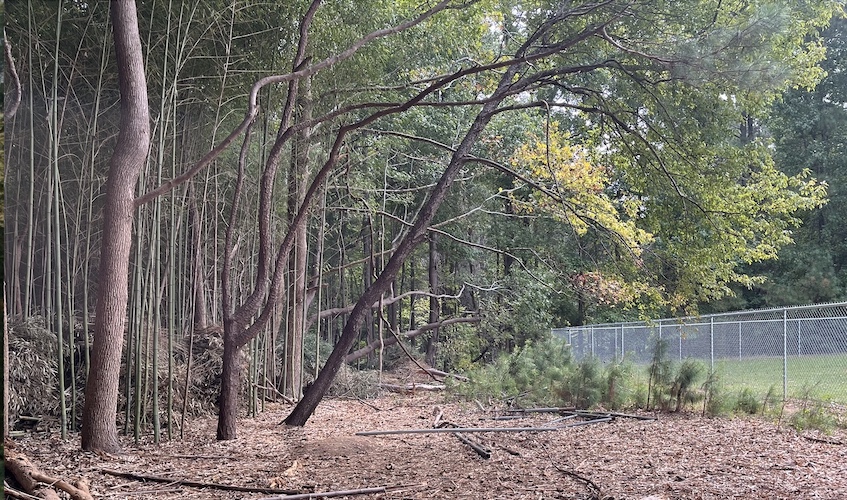
Removing the bamboo cane by cane, east to west, slowly revealed that line of misshapen trees, parallel to the fence line.
In their search for sunlight, the native trees, overwhelmed by the bamboo, had contorted themselves into almost unrecognizable forms. First, there is a sweetgum with an enormous, trunk-size branch growing toward the south, only a few feet off the ground.
An American sycamore (Platanus occidentalis), with its long, skinny branches stretching almost impossibly far south, demonstrates its own inherent strength. Next is the black cherry (Prunus serotina) arcing gracefully in the same direction.
The cactus-shaped pine had split into multiple trunks as it struggled to find a path to sunlight. Beside it is another pine tree surrounded by bamboo canes almost as evenly spaced as the steel bars of a prison cell.
Nearby, an American holly (Ilex opaca) growing straight and branchless for more than 30 feet with at least four bamboo canes growing into its canopy, quietly engages in a life-or-death struggle high above the heads of bikers, hikers and dogwalkers occasionally passing along. Another mature pine grows tall and straight to the height of the bamboo before angling suddenly toward the open Berkeley athletic fields to its south, leaving just a deformed growth continuing straight up. Creases at the angle in the main trunk communicate the stress imposed on the tree by the surrounding bamboo.
As these trees came into view over the weeks and months of our work, I thought about how each offered physical evidence of its own battle against the infestation of invasive plants.
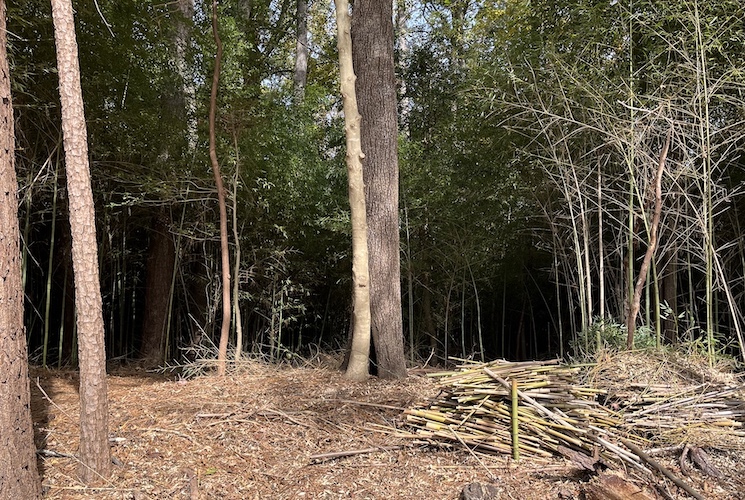
The struggle is not just written on these individual trees. Acres of forest are similarly encased in a bamboo prison. Moreover, it is not a static confinement but a relentlessly expanding one. In late April, new bamboo suddenly sprang from the ground. The growth spurt instantly made the patch denser, popped canes up all around the school’s baseball field, and even forced them up from cracks in the hard-surface Berkeley parking lot.
Invasive plant infestations are quietly, relentlessly transforming our local landscape. It often just looks like the background green we see driving down the road. The scores of autumn olives in the woods across the road from my Williamsburg neighborhood are visually unremarkable at a glance. But these invasive bushes will crowd out the native species in the area, making it unlikely that many of the tall trees there will be replaced after they fall. Autumn olives will predominate, and they are not a host plant for any native species.
On the W&M campus, besides the wisteria infestations, thorny wineberry canes have smothered eastern red cedar seedlings and other small plants at the eastern end of Crim Dell. This summer, we found young Himalayan blackberry canes beginning to march across an intramural field. In the Pacific Northwest, these aggressive plants have dramatically altered the landscape, with myriad and unpredictable ecological consequences.
In this region, we have beautiful, productive native plants, many with the commonwealth’s name embedded in their scientific designations: the sweetbay magnolia (Magnolia virginiana), Southern live oak (Quercus virginiana) and eastern red cedar (Juniperus virginiana). Our landscape, though, is being warped tree by tree, forest by forest, on a campus-wide, regional and continental scale.
The costs are incalculable. The World Wildlife Fund (WWF) Living Planet Report 2020 assessed that invasive species of all kinds accounted for 14.4% of threats to North American biodiversity, behind only habitat loss or degradation and species overexploitation, and well above pollution and climate change. The ongoing collapse of biodiversity is an existential threat to the planet.
Fortunately, Tony Orband, associate director of W&M Grounds & Gardens, and Chad Peevy, W&M urban forester, are working with the Virginia Department of Forestry to address the bamboo infestation, decades in the making, at the necessary scale. Combined with the sustained efforts of the William & Mary community, we’re fighting back against these ecological invaders.
How can we help? Just by thinking about what we plant in the ground during our own lives and how that will grow into the future.
Here are a few additional resources:
-
A list of plants that Virginia has classified as invasive is available through the Virginia Department of Conservation and Recreation.
-
The Virginia Native Plant Society offers guidance on appropriate native plants in the commonwealth.
- Homegrown National Park is an organization that advocates for growing native plants to support healthy wildlife populations. It also provides guidance on appropriate native plants by location.