An Agile Mindset
June 10, 2026
By
Katherine A. Rowe
William & Mary President
At the turn of this century, in 2001, gathered around a whiteboard, 17 software developers penned “The Agile Manifesto.” What they penned is concise: four values, 12 principles, designed for organizations that evolve with customer needs. Focusing on value, they prioritized people, collaboration, and adaptability. Their core principles included early testing of ideas and close listening. Back in my brief life as an ed tech entrepreneur, I learned this approach, called “Agile” design. It is similar to the theater rehearsal processes with which I was familiar as a Shakespeare scholar.
My column this June is about how an agile mindset can be useful for William & Mary in 2026 in our next strategic planning effort. This year, while holding long-term goals in mind, we are focusing on near-term actions that advance student outcomes. The process we are using prioritizes our people, collaboration, and adaptability.
Planning for the long term is one of the superpowers of a university. W&M’s Royal Charter famously establishes “a certain place of universal study … in all times coming.” Through our long history, we have held to that vision for a university where breadth of knowledge provides essential preparation for the future, even (and especially) in tumultuous times. As a colleague commented this spring, our current moment is one of swift change. The advent of artificial intelligence, shifts in rankings, changing demographics, an unsettled political climate, and the uncertain world of NCAA athletics all make it difficult to forecast even six months out. Building agility into our planning process is an effective way to handle such uncertainty while holding to long-term goals.
We have designed a process with five clear areas of focus — throughlines that will last — and the flexibility for different parts of the campus to test and refine actions in each of those areas. A well-defined framework familiarizes our community with a key set of questions that we expect to keep returning to. Over the coming months, we aim to empower our community to advance concrete proposals that solve for the opportunities and challenges outlined in this framework.
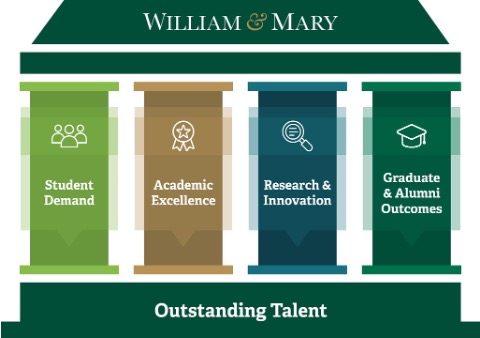 As readers may recall from my column last fall, W&M identified four areas essential to sustaining our mission: student demand, academic excellence, research & innovation, and graduate & alumni careers and outcomes. These mandates emerged from scans of the higher education and business landscape and conversations with our leadership boards, students, faculty, and staff. Since I last wrote, we added a fifth imperative: a focus on recruiting and retaining talented faculty and staff. Picture these four mandates as pillars supported by a foundation of outstanding talent.
As you can see, these imperatives are evergreen. Through the mid-century and beyond, success in these arenas will be essential to sustaining W&M’s national preeminence. Over the next decade, we will advance W&M’s position in each area. Between now and next Charter Day, five working groups, each led by a senior administrator and a dean, will gather recommendations for near-term strategic actions from our community and identify those of highest potential.
We invite you to explore the timeline and work plan at our Strategic Planning website. This spring, each working group introduced its key opportunity statements to the campus via brainstorming sessions. We have invited faculty, staff, students, and administrators to share their suggestions via a structured format by the end of May. Over the summer, the working groups will engage experts and stakeholders as they sharpen suggestions gathered in the spring. As this work advances, we will log our progress on the website.
Reflections of our alumni matter to this planning process. We hope to draw on your insights across many different walks of life. To that end, we invite you in. Please fill out this survey to share your thoughts.
Come the fall, we will share emerging themes and invite further feedback from campus and beyond. This phased process will shape W&M’s next strategic plan. Provost Peggy Agouris and Chief of Staff Carlane Pittman-Hampton Ph.D. ‘03, strategic planning co-chairs, will circulate updates at each stage, so you can hear community input played back as we go.
Throughout this process, we hope you will contribute your perspectives on the key topics and questions around which we are planning.
Onward!
Read planning materials, watch videos, and bring us your best ideas at www.wm.edu/strategicplanning. We welcome your insights as a professional and member of the W&M community. Each person who joins in helps the university evolve to meet the needs of our fourth century.