The W&M Effect
M. Brennan Harris '93 taps into his undergraduate experiences as chair of William & Mary's health sciences department
June 10, 2026
By
Sadie Downing ’26
Photo By
Timothy D. Sofranko
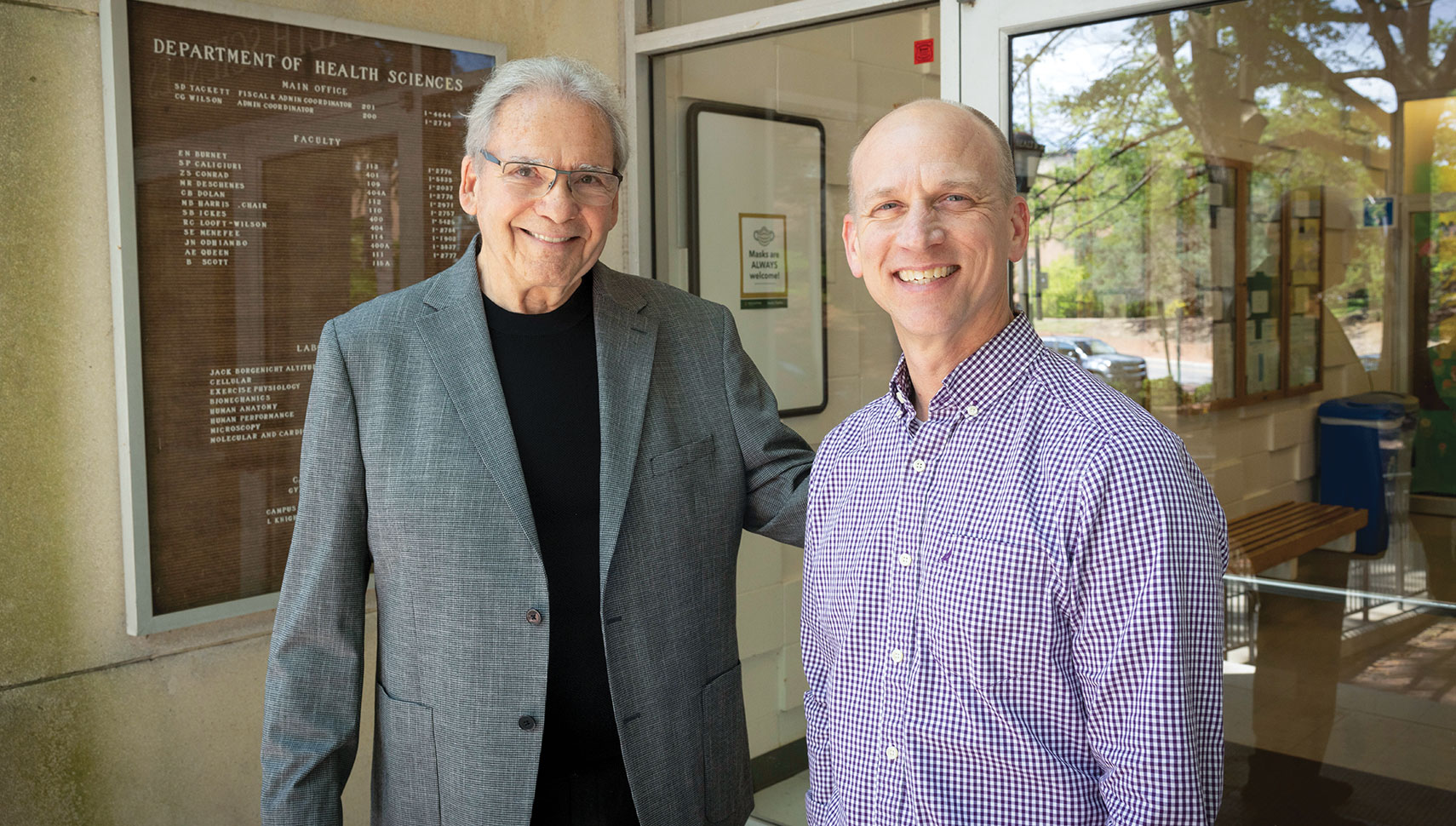
Brennan Harris ’93 didn’t come to William & Mary expecting to major in kinesiology, especially not to eventually become chair of what is now the health sciences department.
He knew when he enrolled in William & Mary that he wanted to major in a STEM-related field, but he first planned to do an engineering program that the university offers in conjunction with Columbia University, in which students spend three or four years at William & Mary and two years at Columbia. However, once he arrived on campus, his interests took him in different directions. While deciding what to major in, he immersed himself in activities. Having run track and field in high school, he threw himself into William & Mary’s running club.
“I was really into training for triathlons,” Harris says, “so I spent a lot of my time, maybe too much of my time, doing that.” He’d always been interested in exercise, which he told his first-year advisor, Hans von Baeyer, now Chancellor Professor of Physics, Emeritus.
Von Baeyer suggested he take a course with the physical education department, which health sciences was then named.
“And I ignored him for 2½ semesters,” Harris says. But in the second semester of his sophomore year, he signed up for his first kinesiology class.
Though he was interested in the material, the biggest draw of kinesiology for Harris was his major advisor, Ken Kambis, who would later become chair of the department. Now a professor emeritus, Kambis taught one of the core classes that Harris took, exercise physiology, and this had a defining impact on his career. Kambis quickly became Harris’ mentor, helping him through much of his decision making, both in college and afterward.
“In all views, Brennan is exceptional,” Kambis says. “He is easy to remember and hard to forget.”
Kambis was aware of Harris’ potential from the beginning of their partnership. “Brennan was probably the best student I had in my 30 years of teaching at William & Mary,” he says. “In an environment that is as replete with great students as William & Mary is, he stood out.”
It seemed like Kambis knew Harris would return eventually; when handing Harris his diploma during Commencement, he had said, “Maybe one day you’ll join us!” Kambis’ prediction was later proven right, though Harris would receive two more degrees and complete a postdoctoral fellowship before returning to William & Mary.
While pursuing his postgraduate degrees in exercise physiology at the University of North Carolina at Chapel Hill and the University of Texas at Austin, Harris continued to trust Kambis’ advice, and the two of them talked frequently, with Harris often asking Kambis what he needed to do to return to the school that had shaped his life so much.
Besides his admiration for Kambis and his desire to get a job like his, William & Mary held personal significance for Harris, as the place where he met his wife, Terri Hamlett Harris ’93. A fellow student, Harris’ wife was in the choir with him, and shortly after their graduation the two of them married in the Wren Chapel.
As a graduate student, Harris dedicated himself to research opportunities, traveling a path he thought he would continue. Despite that, he was always teaching, either in an informal manner to his fellow students or as a paid instructor.
Eleven years after graduating, in 2004, as Harris was beginning his job search after completing his postdoctoral fellowship at Augusta University’s Medical College of Georgia, Kambis called to tell him the kinesiology department was searching for new professors, and he needed to get his application in. While pursuing his postgraduate studies, Harris had realized that William & Mary provided a unique and fulfilling environment for faculty because of its balance between research and teaching. He jumped on the opportunity to apply, and soon he was back at William & Mary, this time as a faculty member.
“He was uniquely qualified, to say the least,” Kambis says.
Harris’ journey from his undergraduate years at William & Mary to becoming a professor and chair of his department was influenced not only by Kambis but by the health sciences department itself. Though the department has changed from its previous name, kinesiology, to health sciences in just the past year, the shift started with Kambis, who updated the name to kinesiology and health sciences in 2009.
“It better represents our work,” Harris says about the most recent name change.
When Harris became chair, he wanted to continue Kambis’ work of developing the department, leading him to add new degree programs in fall 2025. These programs, in human health & physiology and public health, now have about 155 declared majors. The department overall boasts on average 225 majors, making it one of the largest degree programs at William & Mary. Harris has also hired six new professors who have broadened the scope of the department, which currently has 11 full-time faculty members. Other programs, such as ones that required undergraduates to take activity-based classes within the department, moved into the Student Health Center and the Department of Campus Recreation, and are no longer part of the degree. However, health sciences has made sure its doors are open for majors and non-majors alike.
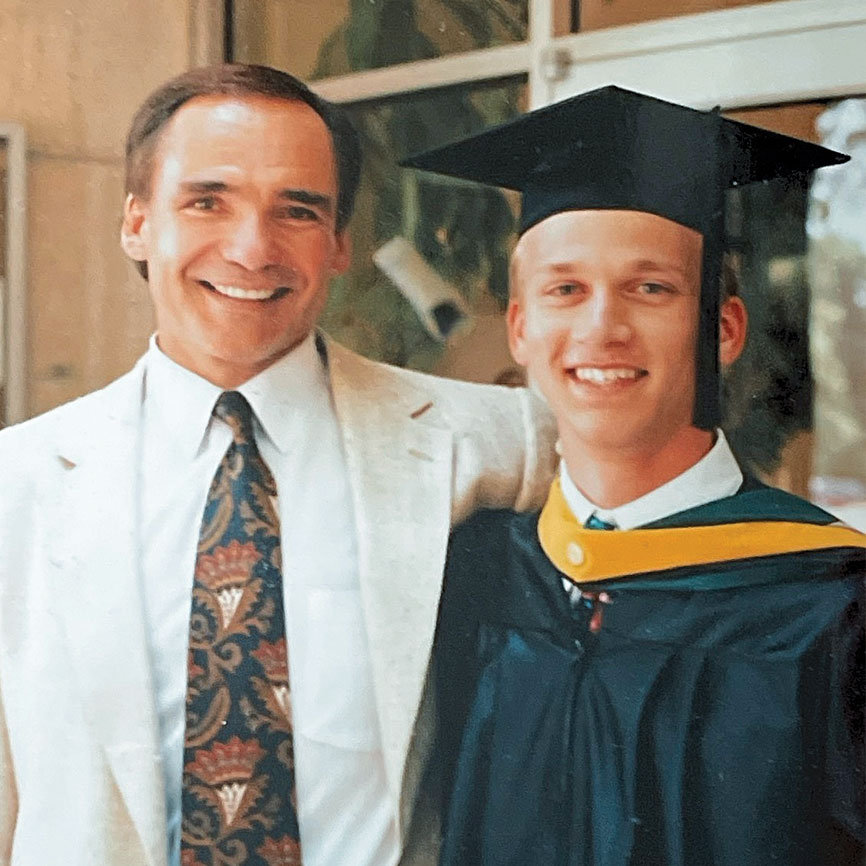
“I can’t say enough about Brennan,” Kambis says. “I think he’s done an exceptionally fine job as our department chair.”
Though Kambis may have been Harris’ most influential professor, he wasn’t the only one. During his freshman year, Harris took a required English class, something he acknowledges was out of his comfort zone.
“In my first seminar, I did extremely poorly,” he says. In particular, he struggled with writing essays, so much so that he kept the grading rubric from his first essay with him over the years as a motivating reminder of that difficult experience. He says that seminar has shaped the way he teaches his own freshman seminar and other classes. Part of it is how he gets students engaged with the material.
“What I tend to do is tell stories,” Harris says. “The other principle is doing my best to take something with a complex value level, like cell signaling pathways, and relate that to actual impact in humans. Such as, ‘Why do I need to know that this molecule is hydrophobic or hydrophilic? Why does that make a difference?’”
The reason it does, Harris says, is “because that means either it can, or it can’t cross membranes easily. And then I get a little metaphysical — because we’re all just stuff. But what makes the difference is the stuff that’s on the inside versus the stuff on the outside and what that brings about.”
Harris attributes William & Mary’s liberal arts teaching style to his success as a professor. Students characterize him as engaging, caring and passionate about his subject.
“Because I had a liberal arts education, I knew that there were other ways to approach things,” he says.
His own experience as a student also makes him an especially authentic proponent of William & Mary as a destination for students interested in health sciences careers.
“First of all, I think, you receive an outstanding education,” he says. “And by that, I mean William & Mary teaches you how to learn and how to think critically. And how to be more open. No matter what you majored in, you come out with those skills, and they’re useful.”
William & Mary uniquely prepared Harris for the varied paths his academic career would take. As health sciences chair, his goal is to develop the department into the best it can be, and that path started with Ken Kambis and William & Mary helping him to develop into the professor, researcher and leader he is today.