A stunning addition to W&M’s Music Arts Center
A rare 19th-century Lindeman Cycloid piano joins the historic keyboard collection
June 5, 2026
By
Annie Powell M.A. ’18, Ph.D. ’24
Step inside William & Mary’s new Music Arts Center on Jamestown Road, and you’ll see a shining glass room filled with historic keyboards. The latest addition to the Historic Keyboard Room is a nearly 150-year-old Lindeman Cycloid piano, a gift from Crissy Hawthorne.
To Hawthorne, William & Mary seemed the perfect fit for the storied piano’s next home, given its previous connection to a W&M family and her vision of the piano’s next chapter. As a musician and music teacher in Charlottesville, Virginia, Hawthorne knows how special the instrument is.
“This piano is a living piece of history,” she says.
The cycloid piano, extremely rare to find today, enjoyed an intense stint of popularity in the late 19th century. Unlike other square pianos with straight backs that could conveniently be pushed up against a wall, the cycloid piano has a rounded back designed to be placed in the center of a room and marveled at from all angles.
This piano’s history goes back to 1878, when it was given as a wedding present to the grandmother of the late Eleanor Pearre Abbot P ’85. Passed down through generations of women in the family, the instrument moved from New York to Maryland to Texas to Ohio to Virginia, finally landing with Abbot, who became Hawthorne’s close friend.
While the piano is remarkable, Hawthorne says, Abbot was extraordinary.
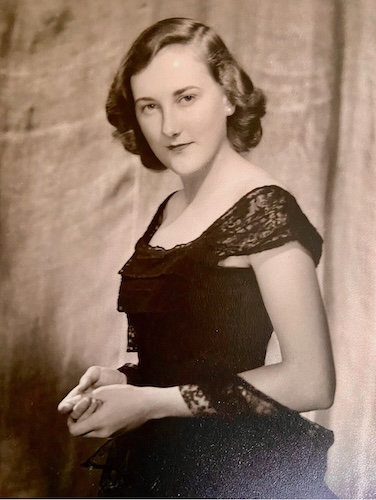
Born in Frederick, Maryland, and educated at the prestigious Maderia School in Northern Virginia and Radcliffe College in Cambridge, Massachusetts (the women’s affiliate of Harvard University), Abbot enjoyed a successful career in historical editing. She worked as an editorial assistant for the Theodore Roosevelt Papers before moving to Williamsburg and becoming an associate editor of the William & Mary Quarterly, the premiere journal of early American history published by the Omohundro Institute of Early American History & Culture at William & Mary.
While an editor of the William & Mary Quarterly, Abbot met her husband, William W. Abbot III L.H.D. ’98, P ’85, then a professor in the history department. They had two sons, one of whom, John Abbot ’85, is a W&M alumnus. The family moved to Charlottesville when William Abbot accepted a faculty position at the University of Virginia.
Historical editing was Abbot’s profession, but according to Hawthorne, she was a true Renaissance woman, knowledgeable in art, music and literature. They met at the Paramount Theater in Charlottesville, when they sat next to each other during an opera performance.
“At intermission,” Hawthorne says, “she reached over and touched my hand and offered me a little piece of chocolate.”
They continued to share a love of opera, as well as exchanging books and attending concerts and art exhibitions. Abbot passed away on Nov. 30, 2024, at age 94. Earlier, when she was moving into assisted living, she asked Hawthorne to take the cycloid piano, a family heirloom.
Hawthorne took the magnificent piano with a condition: One day she would give the piano to a school or museum where it could be used for educational purposes and enjoyed by more people than just herself.
That day came in the summer of 2025, when Hawthorne donated the piano to William & Mary. It was difficult to part with the instrument that meant so much to her friend, but Hawthorne knew that she was making the right decision.
The Music Arts Center at William & Mary, completed in 2023, is a state-of-the-art venue for musical performance, practice and study. A room dedicated to historic keyboards in the new Music Arts Center was first proposed by Tom Marshall, university organist and instructor of organ, piano and harpsichord at William & Mary. Another keyboard in the historic collection is an 1816 Broadwood piano — made by the same manufacturer that Beethoven favored.
The music department offers a course in which students practice on the instruments in the historic keyboard room, one of the main reasons why Hawthorne chose to give the piano to W&M rather than other interested institutions (including Cornell University). The donation was also encouraged by her cousins, William & Mary alumni Randy Hawthorne ’67, J.D. ’70, M.L.T. ’71 and Shelby Smith Hawthorne ’67, M.A.Ed. ’75.
“This is really a feather in our cap,” says Richard Marcus, chair of the music department and director of bands at W&M. “Ms. Hawthorne had the piano fully restored, so it’s in absolutely beautiful condition.”
One of the assets of these historic keyboards is their authentic sound. When played with period music, you can hear how the music was originally supposed to sound, which is often different than how we experience it today.
“The Broadwood piano has a very light sound compared to a grand piano,” Marcus says. “When you hear Beethoven’s music played on it, you can understand that he was writing for that particular instrument.
These historic instruments need to be carefully maintained: Only students taking lessons with Marshall are allowed to play them, and they are kept in a climate-controlled space. But Hawthorne is also emphatic about the need to put the cycloid piano to use.
“An instrument needs to be played to have a life,” she says. “If you don’t use it, it dies.”
It’s a delicate balancing act, to use the piano as it was intended while keeping an eye on its preservation. With this treasured piano’s return to Williamsburg, the next movement in its score begins.