At the Intersection of Art and Service
Tiffany Reed Silverman ’95 teaches the importance of the arts in a military environment as The Citadel’s first fine arts director
October 8, 2026
By
Isabella Dunn ’28
Cadets at The Citadel, the Military College of South Carolina, who minor in fine arts can be seen wearing a patch on their uniform that combines the sharp, structured silhouette of The Citadel’s iconic architecture with the swirling yellows and blues of Vincent van Gogh’s “Starry Night.” The patch visually represents the mission of this unexpected juxtaposition of a flourishing arts program set within a military environment.
For 18 years, Tiffany Reed Silverman ’95, the fine arts program’s founding director, has built the program and her community around that same idea — interweaving strokes of creativity within the military mission focused on duty, respect and honor. She was instrumental in launching The Citadel’s Winfred B. Moore, Jr. Art Gallery and led projects honoring the South Carolina National Guard and those lost in the Emanuel 9 tragedy. In recognition of her contributions, Silverman was named a recipient of the 2026 South Carolina Governor’s Awards for the Arts in the Individual Category, earning the state’s highest honor for supporters, innovators and advocates of the arts.
Duty
Silverman had envisioned a career as a curator, drawn to art as a way to tell stories. At William & Mary, she studied art history and interned at the Muscarelle Museum of Art because she “fell in love with the intersection of visual culture and storytelling.” That interest eventually led her to another intersection: art and the military.
After arts-related positions in museums and media, Silverman began teaching at the college level, but it wasn’t until she took her first step onto The Citadel’s campus that she found her mission. Coming from a military family herself, she said The Citadel “felt like home,” where she could “speak both languages: military and art.”
As she began her journey as an educator, Silverman recalled the impact of the William & Mary professors who invested in her, including Barbara Watkinson, Alan Wallach and Miles Chappell ’60, P ’94, P ’97.
“I had professors who challenged me not only academically, but also in this bigger-picture concept of who I could become,” Silverman said.
Now, she feels her duty is to help her students grow into the people they were meant to become in the very same way.
“I have this one brief shining moment with these cadets, and I want to make it count,” Silverman said. “I want to arm them with the visual perception skills that will protect and serve them for the rest of their lives.”
She began at The Citadel as an adjunct professor, teaching a handful of art appreciation courses, and gradually expanded the program as she built trust with colleagues and students. She says she never set out to create a fine arts program; she simply listened to students’ needs and it all strategically snowballed.
“Just about everything I do here is a first,” Silverman said.
Many students did not initially understand the need for an art program in an environment like The Citadel, but they discovered that the arts demanded the same discipline they valued in other areas of their education.
“Students often underestimate the challenge and creative rigor that we subscribe to in our classes. But once they see themselves as creative, and how it impacts their perspective across the board, they go all in,” Silverman said.
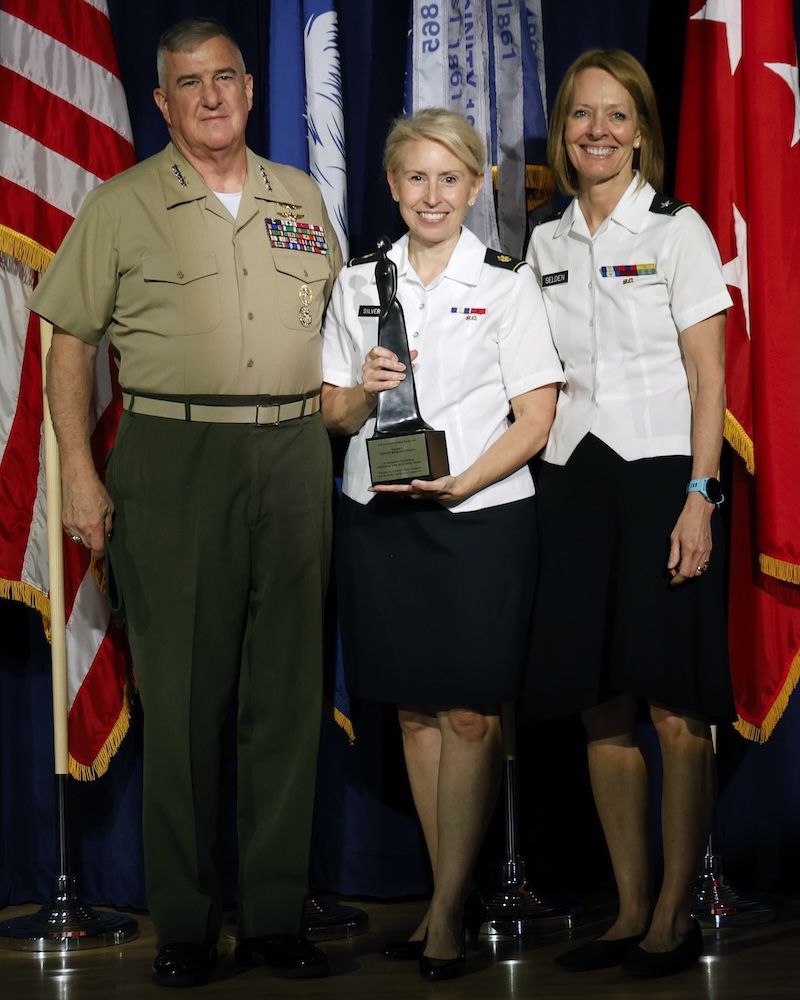
Silverman (center) is shown at the awards ceremony with retired Marine Corps Gen. Glenn Walters, former president of The Citadel, and Sally Selden, the school's former provost.
Today, The Citadel has around 2,400 undergraduate cadets, with about 700 of them taking art classes each year. A point of pride in admissions tours, fine arts is the largest minor at The Citadel, with over 125 cadets currently pursuing it and 500 graduates since it began in 2014.
Because most of her students will not pursue careers in the arts — roughly a third of Citadel graduates go on to careers in the military — Silverman shows them how creative skills can integrate into any profession.
“We are teaching cadets how to assess, analyze and articulate visual information to develop stronger, smarter, more principled leaders in the military and beyond,” she said.
Leadership was instilled in Silverman from a young age by her father, a Marine Corps officer, who taught her the principle of “duty before self” as part of a family tradition of service dating back to the Revolutionary War.
“I feel a responsibility to be part of the solution, and that means using what knowledge I have to make a positive impact in my corner of the world,” Silverman said.
That sense of duty extends beyond The Citadel. Silverman serves on the boards of the Charleston Symphony, The Charleston Museum and the Coastal Carolina Council of Scouting America, as well as the advisory board of the Patriot Art Foundation and previously on the Charleston Commission on the Arts and the Junior League.
“I’ve had a unique seat at the table, weaving military art and education into the cultural fabric of our community,” she said.
For Silverman, that means using the arts to “open conversations rather than close them.”
Respect
Silverman believes the ability to solve creative challenges in an art class develops skills of problem-solving and out-of-the-box imagination that are crucial to success in the military and personal life; she cites “improvise, adapt, overcome” as a mantra applicable to both worlds.
She has seen that value extend past the classroom and into the careers of her former students.
One story involved a Citadel cadet interviewing with the South Carolina Law Enforcement Division, or SLED. When asked if he had any special skills, he mentioned Silverman’s photography class. He now leads the state’s Crime Scene Investigation Unit, and serves as a mentor to the cadets currently taking forensic photography classes on campus.
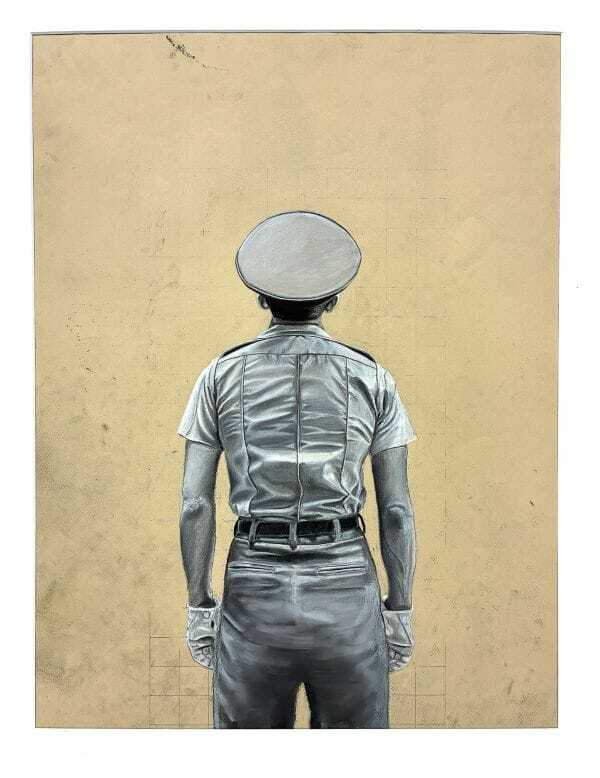
A self-portrait by one of Silverman’s students, Satchel O’Meara, became the banner for the Salmagundi Club of New York’s exhibition titled "Journeys Onward: Military Veterans’ Experiences."
“Creativity is innately human, and the development of your creative muscle is just as strong as the development of any other skills for a modern workplace,” Silverman said.
For some students, the impact is not only professional but also personal; they have found the arts program to be a space to explore artistic pursuits where they otherwise would not.
One student who had never drawn with charcoal created a self-portrait in Silverman’s art appreciation class that became the banner for the Salmagundi Club of New York’s exhibition titled “Journeys Onward: Military Veterans’ Experiences.”
Other students came in with artistic passions, but previously did not have an outlet for them. Silverman said she had heard many cadets say, “I thought I had to give that part of myself up to be a cadet.” In response, she worked to create opportunities outside of The Citadel as well. For example, through a partnership with the College of Charleston, cadets can join its orchestra, which recently performed at Carnegie Hall.
Honor
The intersection of art and the military can surprise people, but Silverman sees it as longstanding. Each branch of the military uses visual art to tell its story, engage the public and honor its personnel.
At The Citadel, Silverman has made that intersection a central part of her work.
Her first exhibition at The Citadel, “Behind the Lines: Combat Artists and the Citadel Experience,” highlighted combat artists she brought to campus to depict cadet life. Its popularity led to a national tour. Since then, she has organized and curated projects exploring military history in partnership with military branch art collections, historic museums, military dance companies, combat photographers, artists and private collectors, including “U.S. Marine Corps Air-Ground Team” commemorating the Marine Corps’ 250th anniversary, and “America’s First Fleet: The Revolution at Sea,” a collaboration with fellow W&M alumnus Roger Bailey ’12, who specializes in naval and maritime histories.
The school’s Moore Art Gallery, which Silverman launched in 2023, now draws close to 4,000 visitors each semester.
In the Charleston community, Silverman was a leader of a coalition to salvage a relief panel created by Willard Hirsch in 1905 as a tribute to the South Carolina National Guard (SCNG) that is now installed outside The Citadel’s football stadium, also home to the current SCNG.
She also led a group of 1,600 cadets and community members in painting the city’s block-long “Charleston Strong” mural in the aftermath of the Emanuel 9 murders. After the killing of nine Charleston residents, one of whom was a Citadel graduate, in the 2015 mass shooting at Emanuel African Methodist Episcopal Church, Silverman thought it was important to honor their lives and help the city process the loss.
Silverman led cadets and community members in painting the city’s block-long "Charleston Strong" mural in the aftermath of the Emanuel 9 killings.
“Every time I look at that street, I see how the mural has become part of the visual culture of Charleston now, and I remember it as a moment that we chose to come together instead of devolving into further violence,” she said.
While Silverman has honored the military through art, she has also been honored herself, receiving one of this year’s Governor’s Awards for the Arts. As only the second person from The Citadel to receive the award, after renowned writer Pat Conroy, she found it “quite an honor to share this legacy with such a legend.”
She was touched by the W&M alumni who showed up for her when receiving her award.
“I feel like we’re there for each other in times of celebration and in sorrow,” she said.
As the founding president of the Charleston alumni network over 20 years ago and recipient of the W&M Young Alumni Service Award, Silverman has remained deeply involved with Charleston alumni, continuing to stay connected to the W&M community that has supported her throughout her life.
Karen Gray Burnett ’72, former president of the W&M Charleston/Lowcountry alumni network, says Silverman was instrumental in obtaining a charter for the organization, establishing a framework of signature events and cultivating a strong set of leaders.
“Our network expanded significantly under Tiffany’s leadership when she was president, and we are very grateful for her continued support and engagement in upholding our alma mater here in South Carolina,” Burnett said.
Silverman hopes to continue honoring her communities — both in Charleston and at The Citadel — through art.
“In the first half of my career, I felt like I was proving the concept that art matters in a military environment,” Silverman said. “Now, the second half is about ensuring that it lasts for the generations to come.”