Powering Up
William & Mary Law School’s Center for Energy Law and Policy charges into a successful second year
October 19, 2026
By
David F. Morrill M.A. '87
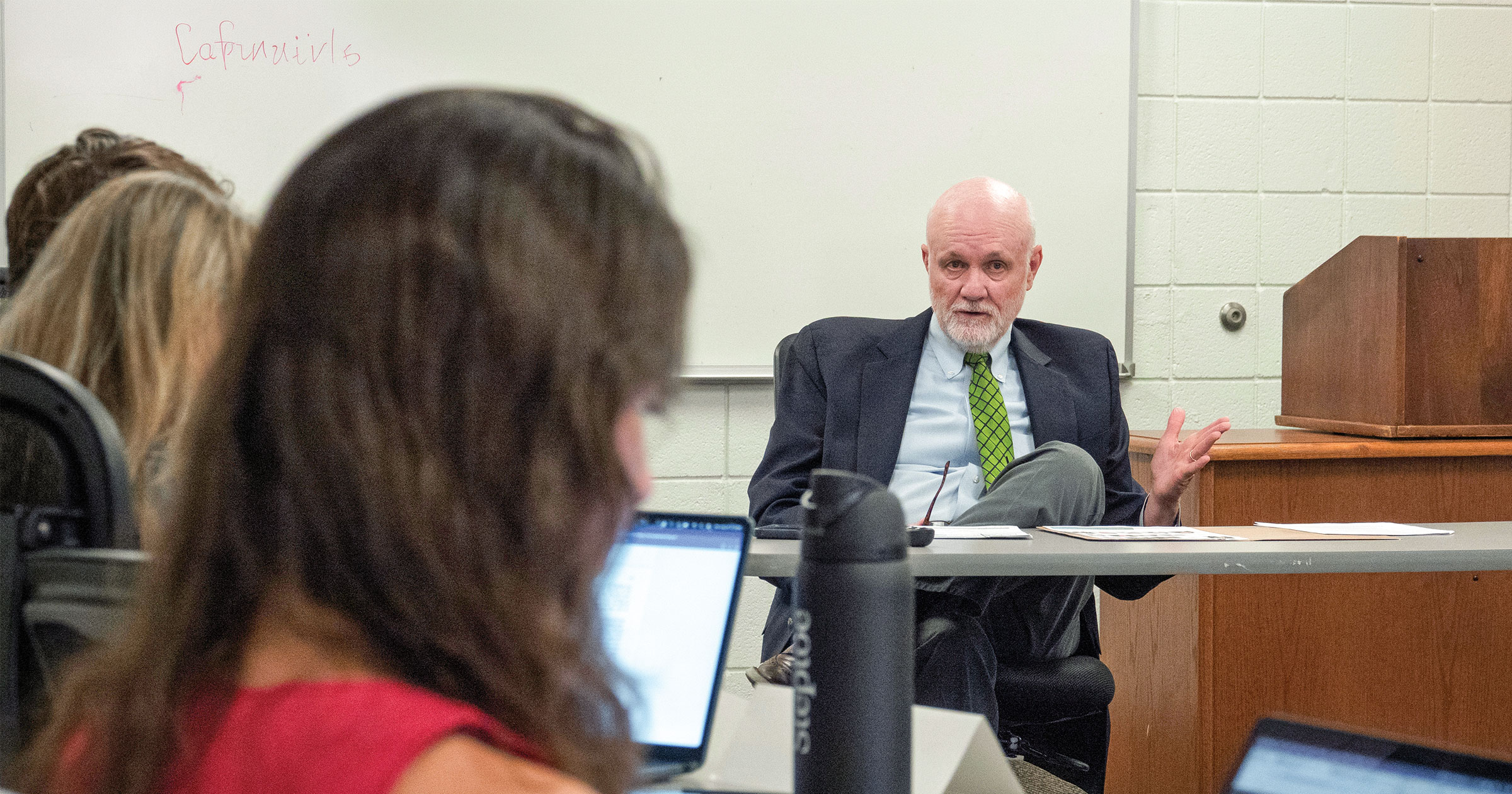
When William & Mary Law School launched the Center for Energy Law and Policy in fall 2025, the goal was ambitious: create a neutral, rigorous space where energy’s toughest questions — including reliability, cost, data center growth and the future of regulation — could be debated on facts rather than talking points. One year later, the Center is delivering on that promise.
Momentum started with the Center’s founding director, Mark C. Christie. A former chair of the Federal Energy Regulatory Commission (FERC), Christie also spent 17 years on the Virginia State Corporation Commission, including as chairman, regulating utilities, insurance and banking. He has led national organizations such as the Organization of PJM States, which oversees the largest power grid operator in the U.S., and the Mid-Atlantic Conference of Regulatory Utilities Commissioners. As a Georgetown Law and Wake Forest University graduate who worked as an underground coal miner to pay for school and later served as a Marine Corps officer, Christie brings a practical, on-the-ground perspective into the classroom.
William & Mary Law Dean and Trustee Professor A. Benjamin Spencer called Christie’s arrival perfectly timed, noting that his regulatory leadership and teaching commitment made him uniquely qualified to build the Center and elevate William & Mary’s voice in national energy conversations.
Christie has been clear-eyed about the Center’s purpose: a forum where environmental advocates, industry and the public interest can all be heard. As he put it, energy may only account for 7% of gross domestic product, but it’s “the foundational 7%” that everything else in the economy depends on.
The issues he flagged early — grid reliability strained by explosive data center growth, and rising costs squeezing consumers — were the focus of the Center’s first year of programming. On May 19–21, the Center held its inaugural Future of Energy Conference in Williamsburg. The sold-out event drew more than 200 energy professionals, regulators and industry leaders to the William & Mary Alumni House for two days of substantive debate.
The conference opened with a headline-grabbing keynote featuring former FERC chairs Neil Chatterjee P ’29, Willie Phillips, Richard Glick and Joseph Kelliher, who discussed the agency’s future amid rapid shifts in energy demand and production. Later panels dug into data center growth across Virginia and the nation, resource adequacy and governance questions raised by surging, data-center-driven electricity demand ahead of a pending U.S. Supreme Court ruling. Additional discussions focused on reliability and affordability challenges facing Virginia’s power grid, underscoring the tension between rising demand and the need for stable, cost-effective energy supply. Speakers represented a wide swath of the industry, including PJM, Dominion Energy, American Electric Power, Southern Gas, Google, LS Power, the Virginia State Corporation Commission and the Southern Environmental Law Center.
Current law students and alumni returned to campus for the event. “I felt immense pride returning to my alma mater as a practicing attorney and participating in conversations about some of today’s most pressing energy issues,” says Shianne Randolph ’21, J.D. ’25, energy associate at Christian & Barton LLP. The event also delivered 7.5 hours of Virginia CLE credit, including ethics training, for attending legal professionals.
The conference’s relevance was underscored by the media attention it drew from outlets including Bloomberg Law, RTO Insider and S&P Global.
Shortly after the conference, William & Mary Weekend in Washington, D.C., hosted a panel focused on the new Center. Joining Christie were Chatterjee and Darpan Kapadia ’95, chair of the William & Mary Foundation and CEO of LS Power.
Christie’s contacts and efforts have built a highly engaged advisory board for the Center. “It’s a strong board and a stellar lineup,” he says, adding that most board members have undergraduate or law degrees from W&M. Like any academic board, they provide knowledge, information and advice, and help raise the crucial private support that allows the Center to thrive. So far, donors have given more than $500,000 through the Center for Energy Law & Policy Fund (6054).
Asked how he’d define success over the next three years, Christie points to the Center’s achievements in a short amount of time — chiefly, putting W&M Law School at the center of the national energy conversation.
“We’ve already achieved that and want to maintain it and build on it,” Christie says. “We also want to be very student-focused, providing students with funded internships, scholarship projects and research papers, and bringing energy and industry leaders to campus to talk with them.”
Christie says his goal is to provide students with practical insights grounded in his regulatory experience. “I teach from a very practical standpoint because I have been both a regulator and teacher,” he explained. He has taught at the University of Virginia School of Law, Virginia Commonwealth University and previously at William & Mary, and his experience also includes international teaching through the Fulbright program.
Jonathan Hagy, a second-year law student, took the inaugural class last fall, and he’s glad he did. “I’ve always been interested in energy affordability and how, when and where energy infrastructure is developed,” he says. “Judge Christie’s Energy Law course was a perfect fit for my interests. He addressed each of these topics, drawing on his own unparalleled knowledge and experience, as well as hosting many excellent guest speakers.”
Concurrently with the course, Hagy externed for Virginia’s State Corporation Commission, where he saw what he learned play out in front of him. “After the course ended, it continued to benefit me in my 2L summer internship,” he says. “I was asked by my firm to complete a complex assignment regarding the Federal Energy Regulatory Commission, and it led to the firm wanting to publish my findings in an article. I could not have completed the assignment, much less understood the material I was working with, without Judge Christie’s class.”
Christie is teaching a class on regulatory law and public policy this fall and preparing to teach his energy law course again next spring. The fall class has full enrollment with students who are highly engaged, says Christie.
Christie credits the Law School’s leadership for making the Center possible. “I really cannot say enough about Dean Spencer’s vision, his leadership and his courage,” he says. “Starting up a brand-new academic center is a bold move, and he made it. I salute his willingness to take a risk and say, ‘This has tremendous potential.’”
That potential is already being realized. The Center is promoting its next major conference, set for May 26–27, 2027, in Williamsburg.
“Last year, we only had about four to six months to bring that off from scratch,” Christie says. “Now we’re looking forward to having an entire year to plan and organize. I think the potential for this Center for William & Mary Law School is unlimited.”