Spring 2026 Issue

1776 Revisited


Interview By Annie Powell M.A. ’18, Ph.D. ’24

Illustrations By Laura Barrett

Spring 2026 Issue
1776 Revisited

W&M alumni historians reflect on the 250th
anniversary of the United States

In July 2026, the United States will celebrate 250 years of independence. At William & Mary, we have been reflecting on our university’s role as the Alma Mater of the Nation in this momentous year.

The Historians

Emily Sneff Ph.D. ’24 is an expert on the Declaration of Independence and a consulting curator for exhibitions marking the 250th anniversary of the Declaration at the Museum of the American Revolution and Historic Trappe. She is the author of “When the Declaration of Independence Was News,” published by Oxford University Press in April, which follows how news of the Declaration of Independence spread to people throughout the United States and the world.
Michael Blaakman ’09 is an associate professor of early American history at Princeton University. His scholarship focuses on politics, empires and borderlands during the age of revolutions. His book, “Speculation Nation: Land Mania in the Revolutionary American Republic,” was published by the University of Pennsylvania Press in 2023, and examines the wave of land speculation that swept the United States in the first quarter-century after its founding.
Jim McClure M.A. ’77, P ’09 is the general editor of “The Papers of Thomas Jefferson,” an editorial project at Princeton University that is preparing a comprehensive scholarly edition of documents written or received by Thomas Jefferson. He led the production of a digital exhibition on the Declaration of Independence in preparation for the 250th anniversary of the United States

In July 2026, the United States will celebrate 250 years of independence. At William & Mary, we have been reflecting on our university’s role as the Alma Mater of the Nation in this momentous year.

William & Mary counts four presidents among its alumni, three of whom served during the founding and early republican eras: George Washington, Thomas Jefferson and James Monroe (the fourth, John Tyler, served just before the Civil War). The College Company — established by Patrick Henry on William & Mary’s campus in October 1775, seven months after he delivered his famous “Give me liberty, or give me death!” speech at St. John’s Church in Richmond, Virginia — participated in four documented military actions during the Revolution.

The author of the Declaration of Independence, Thomas Jefferson, and fellow signers George Wythe, Carter Braxton and Benjamin Harrison V all shared close ties to William & Mary. Their lives reflected both the soaring aspirations and the unfinished complexities embedded within the nation’s founding — including the enduring question of what the “pursuit of happiness” truly means, and for whom it must be realized in the continuing work toward a more perfect union.

Early American history isn’t just a part of William & Mary’s past; it’s a critical part of the university’s present and future as well. With the No. 1-ranked U.S. Colonial American history graduate program in the country and as the founding sponsor and host of the Omohundro Institute for Early American History & Culture, William & Mary is leading the way in understanding our nation’s past and its connections to our present moment.

Historical scholarship is a conversation between experts, an exchange of ideas to approach as closely as possible to the most complete and accurate interpretation of the past. We gathered three historians of early America, all alumni of W&M’s Harrison Ruffin Tyler Department of History, for a virtual conversation to reflect upon the founding of the United States 250 years ago.

In their discussion, Emily Sneff Ph.D. ’24, Michael Blaakman ’09 and Jim McClure M.A. ’77, P ’09 shared their perspectives on the nature of the historical craft, the composition of the Declaration of Independence and the meaning of the United States’ 250th anniversary. An edited transcript of that conversation is below.


The United States declared its independence from Great Britain in a document signed by 56 delegates to the Continental Congress. One of those signers was George Wythe — a Williamsburg lawyer who became the first law professor in the 13 Colonies when W&M established its law school in 1779. Thomas Jefferson, who studied under Wythe before graduating from W&M in 1762 and later drafted the Declaration, called Wythe “my earliest and best friend … [to whom] I am indebted for first impressions which have had the most salutary influence on the course of my life.”

The Declaration of Independence is one of the foundational documents in the creation of the United States. Can you dissect this critical document for us?

MCCLURE: There are really three pieces to the Declaration: the prelude, the grievances and the actual statement that says that we’re now free and independent states. Everything in the document leading up to that statement of independence provides the background to be able to say: We’re done with Britain. It’s important to understand the Declaration as a functional document that has to introduce its reasoning for separation before the actual declaration of independence.

SNEFF: It’s absolutely true that the document itself was an action. Thomas Jefferson wrote to Richard Henry Lee, a Virginia signer of the Declaration, and tried to get him to agree that Congress butchered the Declaration with their edits of it. And Lee told Jefferson (and I’m paraphrasing here): “Yeah, they butchered it. But you know what? The Declaration in itself is what matters. We declared independence. That’s the point.” The document could have said anything, but the action it took was what was essential.

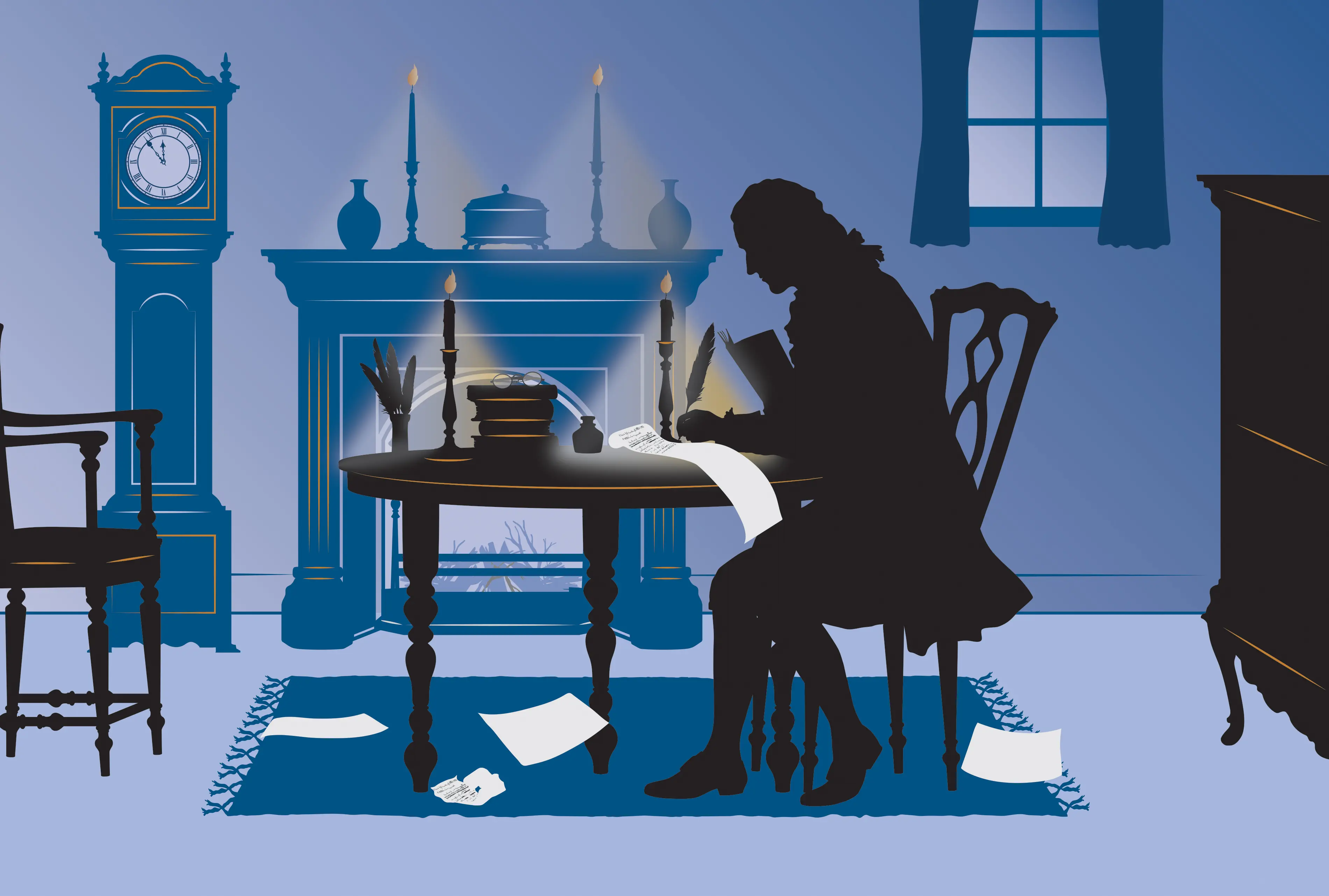
Drafting a Nation: Thomas Jefferson drafted the Declaration of Independence in June 1776 while renting the second floor of a house in Philadelphia.

The American Revolution was a foundational event in United States history, bringing 13 separate Colonies that were united only by their Colonial status to Great Britain into a signle political entity. Burned indelibly into American national memory, the Revolution has been researched by historians, studied by children across grade levels and mythologized in popular culture through literabure, film, theatre and art.

What do you wish people understood better about the American Revolution and founding era?

SNEFF: So often, the Revolution is broken down into a patriot-loyalist binary that is just not accurate to lived experience. If we get back to the letters, the diaries, the firsthand accounts of what people are experiencing, you find that a lot of people just wanted to keep living the way that they were. They didn’t want to experience revolutionary change. I think that is a very relatable perspective for a lot of people today. They just want their families to be safe, their businesses to be successful and their religious communities not to be broken up by political moments.

It’s also important to acknowledge that people’s so-called loyalties were shifting, very much based on the direct impact that the Revolution was having on their life. Quakers in Philadelphia could coast along until they started being threatened, or members of their community were being expelled, or they had to deal with a British occupation of the city. And the same things were happening in other communities all over the East Coast.

BLAAKMAN: One thing that I face with students coming into my classes all the time is that people tend to think that the colonists were aching to escape the big, bad tyrannical grasp of the British empire. But up until almost the very end, colonists were trying to fix the British Empire, not leave it. Up until late 1775 or very early 1776, independence was not the goal. Then suddenly it became the goal in a really fast turn of events.

This is to say that history changes very quickly. Attention to historical contingency is important for us as historians because it helps us build better arguments about change over time. But it’s also something that I hope people will focus on at the 250th, because understanding how much history can change on a dime can be empowering, even if it’s also a little unnerving at first. American independence was not inevitable. It was a last-minute decision. And when we recognize that the present wasn’t inevitable, it helps us understand that the future isn’t inevitable either, that it’s ours to influence.

SNEFF: Absolutely. And that people are the change-makers. That can be unsettling, but it also can be inspiring.


There are over two centuries of scholarship about the American Revolution. A 2019 review published by The Virginia Magazine of History and Biography estimates that there have been over 900 books written about George Washington alone. Over the course of two centuries, historians' interpretations of the events that shaped the Revolution and the people who lived through them have evolved.

How have studies of the American Revolution changed or stayed the same over time?

BLAAKMAN: Although our perspectives on them have changed dramatically over the years, I’d say our field centers on a set of enduring questions: Why did the American Revolution begin? What were its consequences? In what sense was it revolutionary? Who was it revolutionary for? Those are questions that were debated right from the era of the Revolution itself.

MCCLURE: There has been a considerable deepening and broadening of questions, too. I was in grad school back during the U.S. bicentennial in 1976. Back then, what everybody understood and read about the American Revolution was all about texts and ideas of famous men. But there was also this big shift happening in history, of moving toward community-focused social history. We started asking questions like: How do we understand the experience of people who weren’t writing famous texts and were not full participants in the political process? What was the revolutionary experience for them?

BLAAKMAN: Yes, and that sense of whose stories matter has just kept expanding. So nowadays historians investigate the Revolution across lines of class and background and status — how women, and Native Americans and free and enslaved African Americans experienced the Revolution and influenced its course and meaning. The geography has expanded, too. We see the Revolution in the context of a broader Atlantic world, and a North American continent far beyond the seaboard. These evolving parameters are constantly changing the way we answer the big questions. One result in the latest scholarship is that the war itself has become much more central to the way we gauge the Revolution’s impact than it was in the classic studies written in the 20th century, which focused mostly on intellectual and political history. The Revolution reached most ordinary people first and foremost as a war.

I think historians have also recently been trying to get past the dichotomies that structured the last century or so of debates about the Revolution: Was the Revolution sparked by political ideas, or was it sparked by material concerns? Was the outcome of the Revolution an expansion of political opportunity, or was it defined by the consolidation of elite power and wealth? A lot of new studies are finding ways to bridge those binaries or dissolve them. This is reflected, for instance, in recent scholarly energy on the histories of finance and money, which are political. Money is a political institution and a social institution.

SNEFF: That makes me think about the museum exhibit that I’m working on at Historic Trappe in Pennsylvania. I suggested we include different currency as part of the exhibit, like Spanish coin and paper money. The rest of the curatorial team was curious when I suggested this, like, “Why do we want these pieces of money in the exhibit?” I said, “Because it’s a political story. Because the choice of whether to consider a currency as valid or not reflected your own politics.” And we have these examples of people grappling with this decision, but I still don’t think it’s an expected part of the interpretation.

BLAAKMAN: We just had this conversation in my Revolution class the other day! We read an excerpt of the diary of Elizabeth Drinker, a Quaker woman in Philadelphia, from the period of the British occupation of Philadelphia. She’s Quaker, so she’s studiously neutral, right? The first time you ask students the question, “What side is she on?” they quite fairly say, “Well, we don’t really know that she’s on any side.” But there’s a moment in the diary when she makes a deliberate choice to exchange Portuguese half joes — gold coins — for Continental dollars, the patriots’ troubled paper money. And that is a political choice. The politics are inherent in the money.


Why are there these changes in interpretation?

BLAAKMAN: I think the reasons we come up with new interpretations or new arguments about the past can be boiled down to three impetuses:

1. We have new questions — questions that people didn’t ask before, or questions that we’re going to ask differently, and often that’s inspired by our own experience in the present.

2. There are new sources, whether that be new documents or new archives that come to light, or sources that we can access more easily and understand better because of the forensic-style work that’s been done over the years by editors like Jim.

3. There are new methods — new ways of analyzing sources, new digital technologies or even artificial intelligence. AI has posed challenges in the humanities classroom, but we are starting to see some examples of historians using it for good in research: to see new patterns and unlock new meanings in the sources we use.

You get those three things — questions, sources and methods — chugging along together, and what you wind up with is the whole basis of scholarly innovation, telling old stories in new ways and finding new stories that we didn’t know existed. Historical scholarship is, by definition, revisionist. Because we can’t just be satisfied with what we think we already know.

Historical scources — both textual (such as letters, account books, newspapers and diaries) and material (including tools, clothing and coins) — allow historians to access a time period that is otherwise inaccessible to us today. Analysis of these sources provides the foundation for the historians' interpretations of that previous era.

How have interpretations about the founding era been influenced by their source material?

SNEFF: A major help has been the increased access to digitized sources. I’m working with digital scans of newspapers in archives all over Europe that I would never be able to see in person. The access that we have to the primary sources allows new interpretations and new connections. And with the Declaration of Independence, it’s a source that everyone thinks they know but, in reality, has these trends over time where public attention is most focused. In 1776, it’s not Jefferson’s Declaration, it’s John Hancock’s [known for his large signature on the document]. Hancock’s is the only name associated with it. That reminder of looking at sources in their own time and tracing them in that way has been super influential for my work, in both the public-facing and more scholarly veins.

MCCLURE: As a documentary editor, in theory, I’m not providing interpretation, and I’m not telling stories. I’m simply editing each document in sequence as it goes. Now, what really happens is that we’re always making decisions: What are we going to annotate in a document? How much are we going to say about these things? How is it going to develop as a thread over multiple volumes? In that sense, we are very much continually rethinking and looking at the documents in a very different way than our predecessors would have.

SNEFF: Total credit to the folks who are working so closely with those original documents. Documentary editors like Jim make them accessible and then make sure that the teachers and museum educators, the folks who are going to interpret the documents for the public, have the right context for them.

MCCLURE: Emily also raises a good point about the importance of tracking documents in their own time. That really came home to us in creating the digital exhibit about the Declaration, because neither Jefferson nor anybody else on the drafting committee documented the drafting process. We don’t know very much at all about the chronology of the Declaration. We have this document that’s considered to be perhaps the most important document in American history and in order to understand anything at all about the drafting process, we have to reconstruct it from clues.

We know that John Adams was involved in drafting, at least twice. Benjamin Franklin [who received W&M’s first honorary degree in 1756] was involved once or twice. There’s one undated letter from Jefferson to Franklin, who was out in the Philadelphia suburbs in the summer of 1776 because he had gout. In the letter, Jefferson basically says, “OK, here’s this thing I wrote. The committee’s looked at it — would you look at it, too?”

The other thing is that Jefferson recorded multiple stages of that drafting process on the single set of pages that he called his original rough draft. And it’s very difficult to unpeel those layers and sort through the sequence of them. This becomes important when you’re looking at things like the phrase: “We hold these truths to be self-evident” — which in the original draft was “We hold these truths to be sacred & undeniable.” At what point did that change come in? And again, the record is silent: We have no idea who suggested that change or how it was done. [The change from “sacred & undeniable” to “self-evident” was long thought to be an edit from Franklin. However, the change was made in Jefferson’s handwriting.]

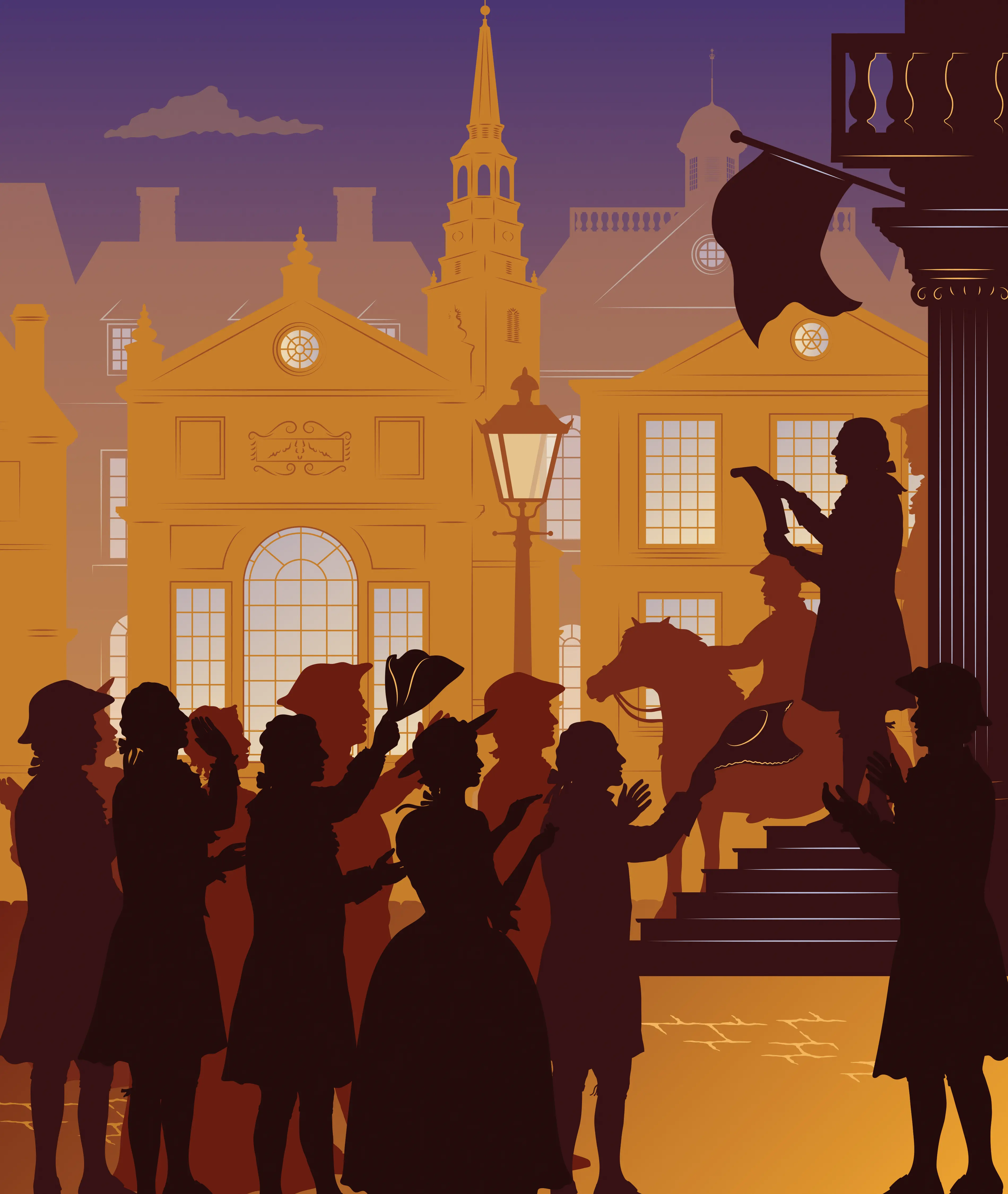
Going Public: The first public reading of the Declaration took place in Philadelphia.

July 4, 2026, marks the 250th anniversary of the signing of the Declaration of Independence and the establishment of the United States of America as an independent nation. Events across the nation — planned by the federal government, independent states and small towns — will honor the occasion. Virginia’s 250th commission, VA250, is holding commemorative events throughout the year and taking a mobile museum with the exhibition "Out of Many, One" on the road across the state.

How do you see the commemorations for the 250th anniversary taking shape in the lead up to July 2026?

MCCLURE: It’s interesting that a lot of the really good, solid activity that’s going on for the 250th is happening at individual institutions. Groups are finding their own way for this anniversary, because there isn’t a national set of guidelines as to how one should observe this. And there are a lot of institutions that are working on exhibits. [The Papers of Thomas Jefferson, led by McClure, has produced a digital exhibit, and Blaakman curated an exhibition with Princeton University Library.]

SNEFF: I’ve been really impressed to see the efforts being made by 250th commissions in some of the Western states, where the Revolution seems a little more remote than in the Eastern states. Hawaii’s 250th Commission, for example, is organizing public readings on July 8, which was the day of the first formal public readings of the Declaration, at 6 p.m. Eastern time, which is a time at which everyone from Puerto Rico to Guam can participate.

BLAAKMAN: I think that’s a heartening takeaway, that so much good work is happening at the local level, and in particular institutions, and that the commemorative landscape is bigger than any political headwinds.

I also really hope that people use the 250th as an opportunity to learn more about individuals they have not heard of before, and how those lesser-known people experienced and navigated the tumult and the chaos and the fear and the violence and the promise and the possibility of the Revolution.

SNEFF: The flip side of this is that there is also a history of civic action on the Fourth of July. We can look back to the centennial anniversary in 1876 when the National Women’s Suffrage Association interrupted the formal ceremonial proceedings. There is a kind of duality for these anniversaries — where it brings people together but also invites people to push for more.

W&M is currently celebrating its Year of Civic Leadership, honoring the university’s enduring commitment to service, public stewardship and leadership in service of the common good. James Monroe, fifth president of the United States and William & Mary alumnus, showed that commitment to service when, as a student, he enlisted in the Continental Army's Third Virginia Infantry Regiment in 1776. Monroe accompanied George Washington in the famous Delaware River crossing, was wounded at the Battle of Trenton and retired from the military at the rank of lieutenant colonel. After decades of public service, he was elected president of the United States in 1816 and 1820. His home, Highland, is part of William & Mary.

What did civic leadership look like in the 18th century, and how does that compare to today?

MCCLURE: Jefferson said much later that his task with the Declaration of Independence was to capture the sense of what was thought at the time. And Jefferson believed that there would be a relative unity of thought, that thoughtful people would agree on many things. That’s kind of the Enlightenment view that he had. But he understood also that what he and the Continental Congress were doing was helping to shape what people thought and fought about. And so, in a way, they were guiding and showing people how the formation of an independent government is done. In all of the Colonies, there was a tradition and an understanding of how things got done — with civic leaders meeting together in assemblies and putting words down on paper and taking certain formal steps. So, in terms of current civic leadership, we need to continually remind ourselves that the words matter, and the formal instruments matter, to be effective.

SNEFF: Williamsburg is a pretty good place to think about civic leadership. The resolution that ends up snowballing into the Declaration of Independence comes out of the Virginia Convention in 1776 in Williamsburg. There is a model, right down Duke of Gloucester Street at the Capitol, of taking action — not just making speeches or writing in private correspondence about what you wish might happen but actively pushing forward and banding together for the common good.

BLAAKMAN: In the late 18th century, civic leadership was about disinterest and virtue and vigilance. And, if we’re talking about after 1776, it was about an understanding that republican self-government is a very fragile thing. To add one more Jefferson example onto the pile here: In the exhibit that I’ve been working on at Princeton, we have a letter written by Jefferson during the ratification debate. He was in Paris at this point. He had to sit out the Constitutional Convention, which I think was a bit of a bummer for somebody who probably would have loved that intellectual exercise. Anyway, Jefferson gets a copy of the proposed Constitution, and he reads it and writes a letter with some of his opinions back to Uriah Forrest, a delegate to Congress from Maryland. Jefferson thought the Constitution was an improvement on the Articles of Confederation, but he also was a little bit apprehensive about it. As he saw it, the whole framework was rooted in a belief among the framers that subsequent rulers would be as virtuous or as honest as themselves. And he pointed to that as a flaw in the constitutional framework. I think that’s a very explicit illustration of what civic leadership meant to somebody like Jefferson in the late 18th century, and it’s an enduring reminder for us today.

In 1776, William & Mary was a hub of activity. Students and professors filled the Wren Building with debates over the attraction of revolutionary ideas versus loyalty to tradition. The College Company drilled in the area near Kaplan Arena, preparing for armed battle. And one mile down Duke of Gloucester Street, at the Capitol building, politicians outlined the constitution for the new state — not colony — of Virginia.

We know about this bustle of activity because of the scholarship of historians like Sneff, Blaakman and McClure, who analyze the historical record to present the most accurate interpretation of the past to the public.

William & Mary produced the leading revolutionaries of 250 years ago and the leading scholars of those revolutionaries today. From past to present to future, American history is at the core of the Alma Mater of the Nation.


To learn more about William & Mary’s Year of Civic Leadership during the nation’s 250th anniversary, visit wm.edu/250.