Bridging Divides
Jack Thomas ’22, M.P.P. ’23 helps legislators find common ground and reach policy solutions
June 10, 2026
By
Isabella Dunn ’28
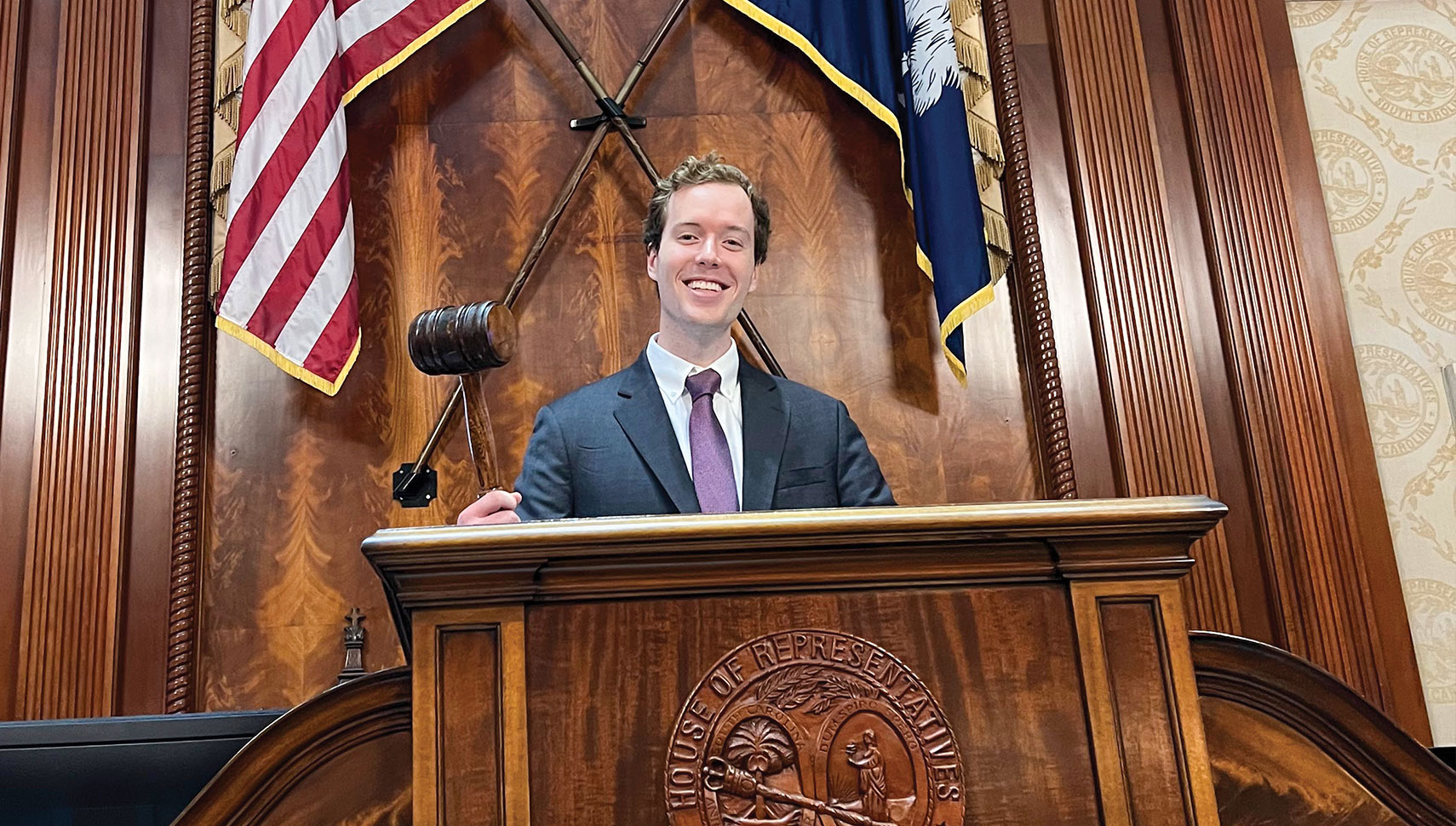
Jack Thomas ’22, M.P.P. ’23 graduated during what he describes as a “forest fire of polarization,” a time when division in the country increased animosity and left many Americans feeling “viciously angry” at those who disagree with them.
He observed these fires of polarization in social media interactions, in public meetings and in how politicians traded personal attacks across the aisle. As decorum continued to degrade on the congressional floor, Thomas saw a contrast between the intense political climate and the culture of civility emphasized at William & Mary. This inspired him to pursue a career where he bridges divides by working with people of diverse perspectives inside and outside of government and politics.
Thomas is the director of congressional engagement and public policy at the National Institute for Civil Discourse (NICD) in Washington, D.C. He works to “try and equip the nation with the tools to engage its political differences more constructively” by creating an environment for civic discussions among legislators across political differences and connecting them with everyday Americans to find solutions.
He and his team create comprehensive policy briefs that accurately capture the strongest arguments for and against legislative proposals under active debate in Congress. They send them out to about 90,000 members from across the political spectrum, who provide their informed opinions on the best approaches to solve policy problems. That input is then shared with Congress during briefings with legislative staff.
Among the key issues identified by members was expanding Pell Grants to cover short-term career training programs such as software bootcamps and surgical technician certificates. By gathering feedback on the logistics of the plan, such as creating quality metrics for for-profit institutions, they helped demonstrate broad grassroots agreement among Americans. The survey results were shared in a bipartisan news release from leaders of the House Committee on Education and the Workforce.
“We have had many successes like that,” Thomas says. “That’s just one of my favorites, because you can see both Republicans and Democrats finding a solution together.”
Thomas also works with state legislators, leading workshops and experiences designed to help them become more collaborative, bipartisan and civil. During one session in Georgia, for example, he facilitated a trust-building exercise that helped a narrowly divided, partisan group of lawmakers develop relationships and skills that lead to successful legislation.
“They came out as better legislators, more equipped and ready to work across the aisle and recognize a good idea when it came from anyone, whether they were a co-partisan or a cross-partisan,” Thomas says.
He says a common misconception is that his team simply lectures legislators on “how to be nice to each other,” but the work instead focuses on honoring others’ values and putting in the effort to understand a range of perspectives.
His mission to find solutions within areas of division is not only a professional one but a personal one that developed during his formative years at William & Mary — starting with the national tensions during the COVID-19 pandemic and continuing through graduation.
He says that William & Mary, a university with roots tied to the nation’s democratic beginnings, reflects that legacy in its culture that keeps “civic engagement enshrined” — providing a strong emphasis on why students should get involved. Thomas says his alma mater helps people see how individual actions connect to real-world impact.
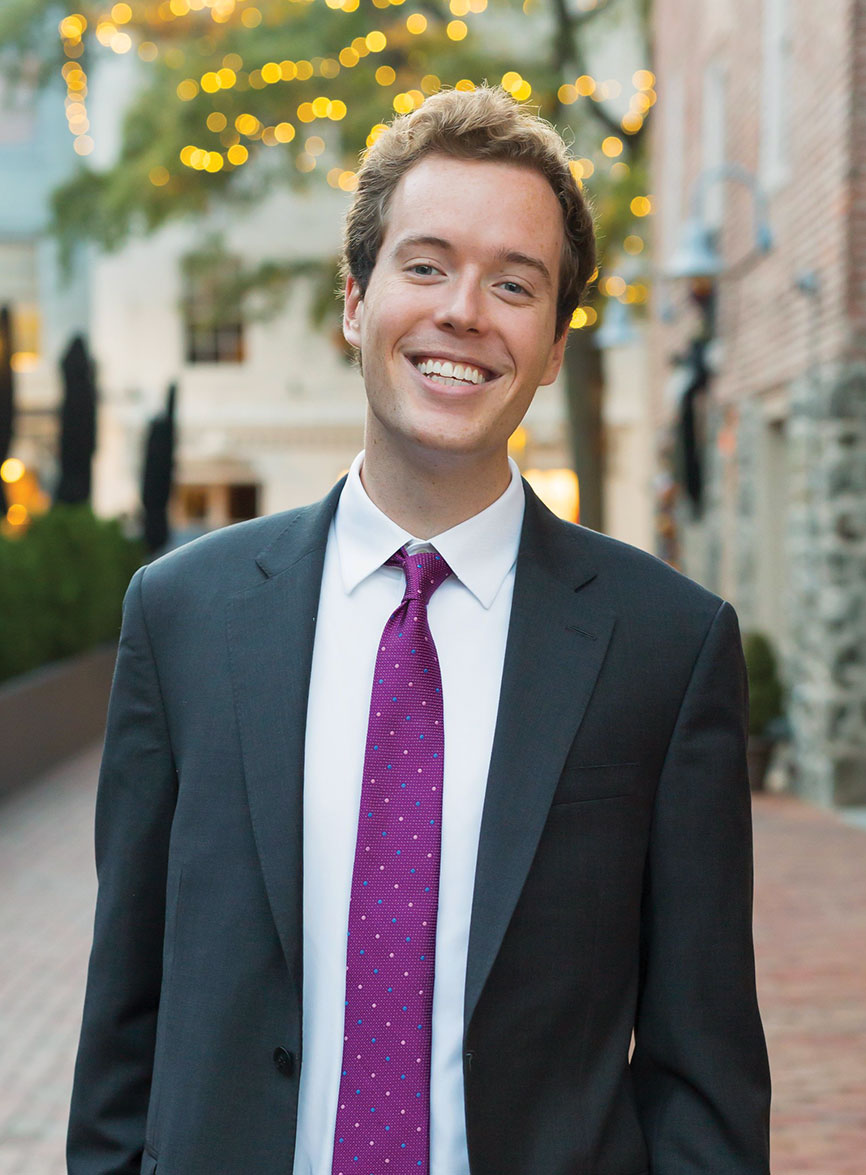
Civic engagement practices students develop at W&M often carry over into their careers. In Thomas’ experience, this is evident in the number of William & Mary alumni in the Washington, D.C., area, where he has friends working in fields such as health policy and international relations. Those whose careers are not directly tied to politics maintain active civic lives by volunteering on local boards or attending community meetings.
“It surprises me how often I’ll run into good friends from William & Mary on the streets or at work events,” he says.
As a student, Thomas became involved in local politics as communications director for the campaign of Caleb Rogers ’20, who was elected to Williamsburg City Council days after graduating from William & Mary. Thomas also saw politics in action on a larger scale during his intensive 10-day winter seminar with the W&M Washington Center, which — despite being virtual during COVID-19 — provided a direct connection to the political life of Washington, D.C.
Another influence for him was Alexandra Joosse, a W&M public policy professor who specializes in social network analysis. Her class blended practical work — using real-world data and metrics — with big questions such as “How are systems of government interacting with one another?” and “What is the relationship between these large, complex organizations of governments and people?”
While a student, he gained firsthand experience in policy in action through a legislative internship with then-Virginia Del. Michael Mullin, whose district included Williamsburg, while helping pass bills in Richmond and advocating for the community. That experience helped prepare Thomas for his work at the National Institute for Civil Discourse, where he serves as director of congressional engagement and public policy. He also completed his master’s in public policy a year after graduating.
When he pursued his M.P.P. at William & Mary, he had the opportunity to apply what he learned by working with the Election Law Program at W&M Law School. There, he helped build a comprehensive dataset of election litigation challenges being brought across courts in four states. Through that work, he and two M.P.P. teammates identified gaps that the nation’s democratic systems are not yet fully equipped to address, challenging them to develop the tools, resources and training needed to help the judicial system respond to these growing issues.
“There’s a world that’s aching for smart, educated people who can approach a problem from a variety of perspectives,” Thomas says.
In his work, Thomas has found that one of the biggest barriers to civic discussion today is the psychological bias leading people to look for flaws in others’ arguments rather than the value in their viewpoints. To combat this bias, he advocates for active listening, which involves “listening for understanding” and demonstrating empathy — a skill that can help build understanding across political divides as well as in personal relationships.
His advice echoes the five principles of W&M’s Better Arguments initiative. Launched in the fall of 2021, the initiative provides students, faculty, staff and alumni with a toolkit for ways to navigate disagreement through community expectations on respectful language when engaging in discussion and community values surrounding civic engagement.
In his professional life, Thomas plans on continuing to make a difference in American politics by attending law school at the University of Virginia in the fall. He hopes to keep working with legislators and use his legal education to strengthen his understanding of policy.
Thomas has remained engaged with his alma mater by returning to the W&M Washington Center to speak to professor Xiaowen Xu’s psychology class, where he discussed the effects of cognitive biases on political polarization. He finds it refreshing to engage with students who are passionate about making a difference. He sees that same energy in W&M students who intern at the NICD, who he says are able to “hit the ground running” in their work.
He adds that he enjoys connecting with fellow alumni, even those he was not close with in college, because “it means something to have gone to William & Mary.”
“It is deeply impactful for me to be able to graduate from William & Mary and go work on something that tries to make our country better,” Thomas says.