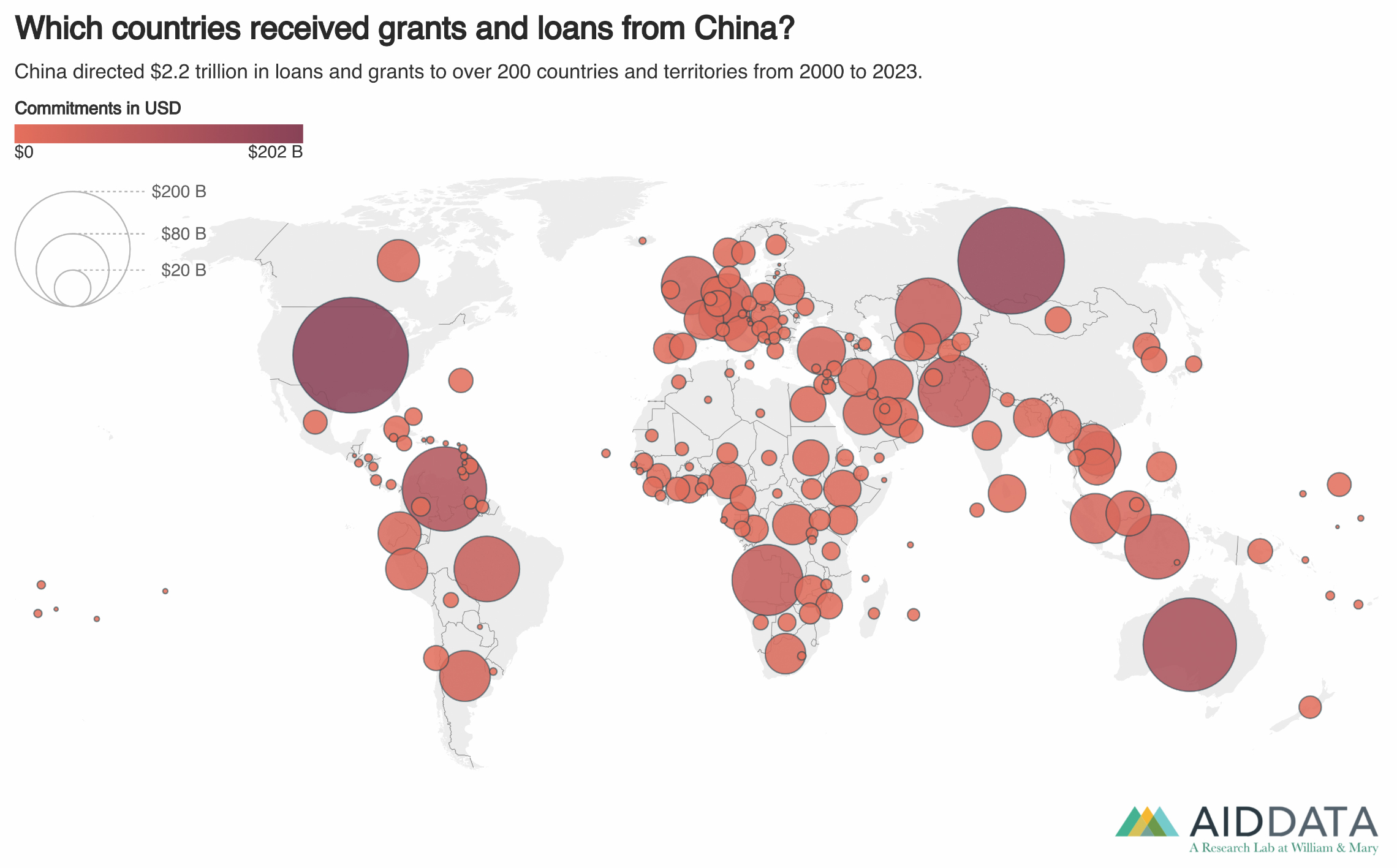
On Nov. 18, William & Mary’s AidData research lab released a new flagship report and massive dataset that comprehensively tracks China’s lending and grant-giving activities worldwide.
The report, based on data collected by William & Mary students, reveals that the scale and scope of Beijing’s portfolio is vastly larger than previously understood: $2.2 trillion of aid and credit spread across 200 countries in every region of the world.
“The overall size of China’s portfolio is two-to-four times larger than previously published estimates suggest,” said Brad Parks, AidData’s executive director and the lead author of the report.
The report underscores William & Mary’s ability as an R1 institution to produce nonpartisan, globally consequential research that shapes policy and strengthens the university’s national preeminence.
While AidData’s previous reports and datasets have focused on developing countries, this report also includes detailed and comprehensive information about China’s secretive lending and grant-giving activities in high-income countries for the first time. This includes the United States, the United Kingdom, Western European countries, Japan and Australia.
The 300-plus page publication — “Chasing China: Learning to Play by Beijing’s Global Lending Rules” — finds that more than three-quarters of China’s overseas lending operations now support projects and activities in upper-middle income and high-income countries.
“Much of the lending to wealthy countries is focused on critical infrastructure, critical minerals and the acquisition of high-tech assets, like semiconductor companies,” said Parks.
Among the findings: The U.S. has received more than $200 billion for nearly 2,500 projects and activities that can be found in virtually every state in the country.
The United Kingdom received $60 billion.
The European Union’s 27 member states received $161 billion for nearly 1,800 projects and activities.
Top deal-making countries include Germany ($33.4 billion), France ($21.3 billion), Italy ($17.4 billion), Portugal ($11.7 billion) and the Netherlands ($11.6 billion).