Inside the World Cup
FIFA Chief Football Officer Jill Ellis ’88, L.H.D. ’16, P ’27 reflects on this summer's World Cup and how William & Mary prepared her to lead under pressure
July 14, 2026
By
Brendan Doyle ’20
and
Jennifer Page Wall
Jill Ellis ’88, L.H.D. ’16, P ’27 is no stranger to soccer’s biggest stage. As head coach of the United States Women’s National Team, Ellis led her squad to back-to-back Women’s World Cup titles in 2015 and 2019. This time around, she is experiencing the tournament from a different perspective. In December 2024, Ellis became FIFA’s chief football officer, helping to cultivate soccer — or, as most of the world calls it, football — around the globe. Even as the sport has taken her to incredible heights, she has continued to give back to William & Mary student-athletes, including as the namesake of Ellis Field at the 1987 Women’s Soccer Team Training Center.
The Men’s World Cup held this summer across Canada, Mexico and the United States has surpassed expectations in terms of attendance and viewership. According to FIFA, over 6 million fans attended matches through the round of 16, and the 50 million television viewers that tuned in to watch the United States’ knockout round clash with Belgium comprised the largest American audience for a soccer game ever recorded. This World Cup is Ellis’ first in her position with FIFA, giving her a front-row seat to the excitement and enthusiasm she helped build with her USWNT success. We asked Ellis about her new role, the continued growth of soccer in the United States and how William & Mary prepared her to lead under pressure.
Q: This is your first World Cup as FIFA’s chief football officer. As you’ve experienced the tournament firsthand, what moments have stood out to you most — and what has it been like to see years of planning come together amid the energy and excitement of fans from around the world?
A: I’ve experienced World Cups as a coach, but seeing one through this lens has given me an entirely new appreciation for what it takes to bring the world’s biggest sporting event to life. It’s easy to focus on the 90 minutes on the pitch, but when you’re part of the broader tournament, you see the countless people behind every match: over 50,000 volunteers enthusiastically welcoming fans at airports and stadiums, the medical teams, referees, stadium staff, broadcasters, everyone working tirelessly behind the scenes. It’s an extraordinary collective effort that has been years in the making.
In this new role, I’ve sat in stadiums and honestly been blown away by the fans. People from every corner of the world, united by the colors of their country, celebrating together, sharing heartbreak together and creating lifetime memories. To see a Cape Verde vs. Argentina match and see fans in U.S., Mexico and Brazil jerseys cheering in the stands reinforces how much the world loves this sport. There really is nothing quite like the World Cup, because it belongs to everyone.
This position with FIFA has definitely reinforced something I learned as a student-athlete at William & Mary: Success is never an individual achievement, and without passion, it’s unattainable. My teammates and I shared a journey built on trust and a shared purpose, and whether a team is 25 or 25,000, I believe those elements are critical to accomplishing something remarkable.
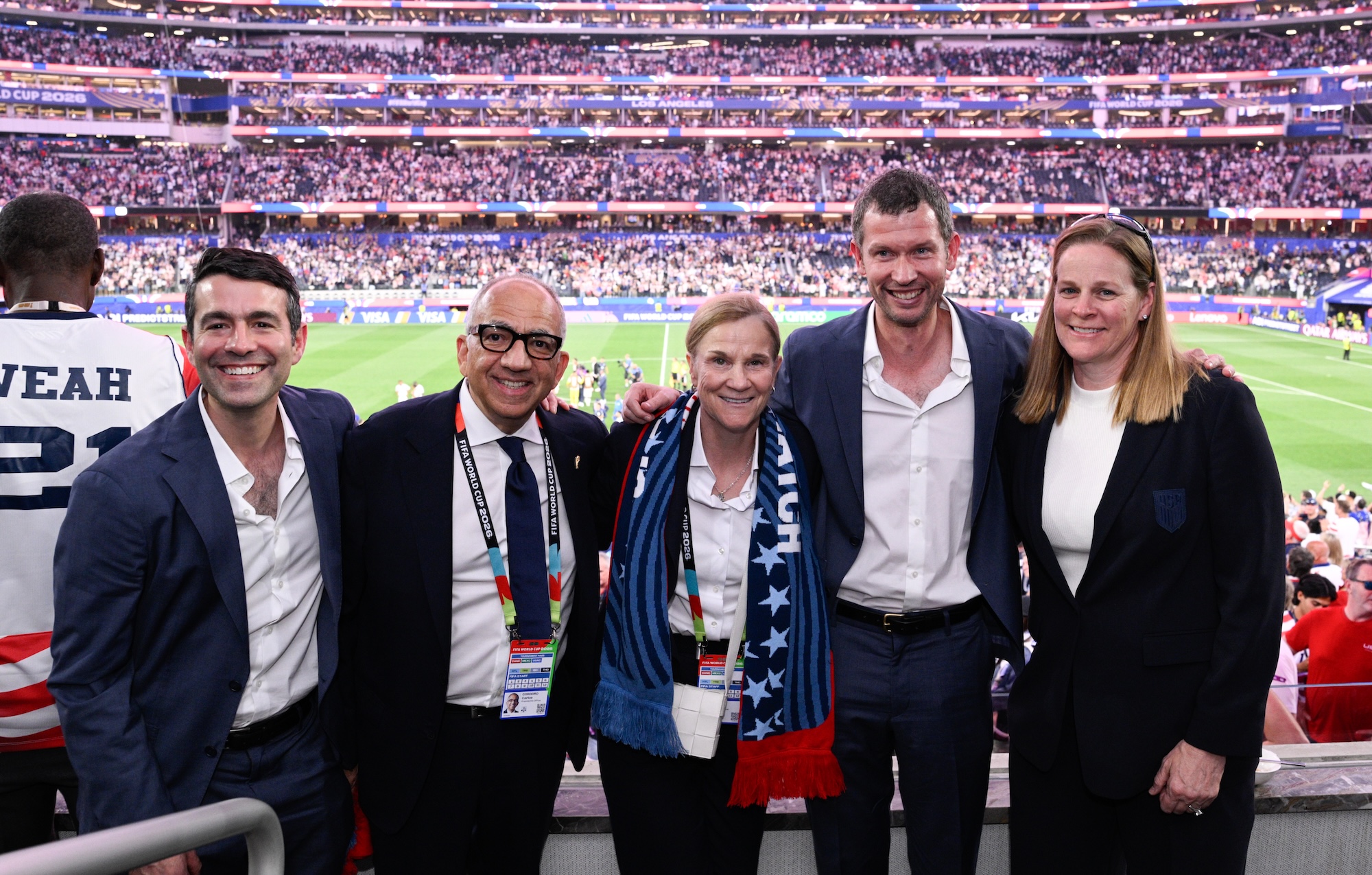
Q: You’ve experienced the World Cup from the sideline as a championship-winning coach. Now, as the chief football officer, you’re seeing it from a much broader vantage point. How has that shift — from leading one team to helping steward the global game — changed the way you think about leadership, impact and success?
A: The fundamentals of leadership haven’t changed for me, but in this global role, the scope of it has broadened. Whether coaching the U.S. Women’s National Team, building the San Diego Wave or in this role now, you’re still building trust, creating clarity, empowering people and trying to bring out the best in others.
Success as a coach or team president is often measured by the immediacy of a scoreline or a sold-out stadium, but I do think coaches also value success over time: the long-term impact of investing in a player, an assistant coach or a coaching philosophy.
Today I think about success even more broadly: creating opportunities, strengthening football environments around the world and working to leave the game better than I found it. That means impacting the number of female coaches in the game. It means helping federations build out football strategies or scouting platforms. It means creating a player impact program so footballers can build a legacy of social impact off the pitch, not just on it. It’s also creating new competitions to incentivize investment and expanding existing competitions to grow the game in more countries.
There is a real tradeoff in this shift. As a coach or team president, the final decision often rests with you; you sit in the proverbial driver’s seat. Now my role is more about supporting and guiding, enabling an informed decision rather than making it myself. That’s not always the natural instinct for coaches, but it’s the role this job requires, and I’ve worked to embrace how best to serve others.
Without a doubt, William & Mary prepared me for that broader perspective of leadership in ways I didn’t fully appreciate at the time. A liberal arts education teaches you to ask questions, consider different viewpoints and get comfortable solving complex problems, lessons that only grow more valuable the further my role moves from the touchline.
Q: Hosting the World Cup gives soccer in America an extraordinary opportunity to build on the excitement surrounding the game. Looking beyond this tournament, what should happen over the next decade to translate that momentum into greater participation, stronger development pathways and a more enduring soccer culture in the U.S.?
A: There has historically been a halo effect from countries hosting FIFA World Cups. Domestic league attendance rises, young people are drawn to the game and heroes are born to inspire the next generation. World Cups create incredible moments, but there is a responsibility, both from FIFA and the host countries, to turn that moment into lasting change beyond the final whistle.
Every host country has a unique ecosystem, and ultimately the federation, in this case U.S. Soccer, is the best steward to identify how to move the amplification of hosting a World Cup into long-term success. U.S. Soccer has shared with us its plan to create alignment within the U.S. soccer landscape, to grow the development pipeline and create more access to the game for youth. Right now, cost and access to playing areas are barriers for young people in the U.S., and our role at FIFA, beyond legacy funding, is to support our member associations with programming like coaching education, collaborative research projects on the game and infrastructure like mini pitches or facility upgrades.
I learned long ago that, ultimately, we are as good as our talent. It is my hope that this World Cup creates a legacy focused on increasing our talent pipeline. The U.S. has already created an amazing wave of interest in this country with the performance of the team, and the greatest compliment we could pay this group of players and coaches is to spawn the generation that competes for a trophy at every World Cup.
Q: You’ve led on some of the world’s biggest stages. When the pressure is highest, what leadership principle do you return to time and again?
A: Preparation is what gives me confidence when the pressure arrives. One lesson I learned early, both at William & Mary and throughout my coaching career, is that pressure doesn’t create who you are; it reveals the habits you built long before the moment arrives.
The other principle I return to is relationships. When adversity hits, people don’t follow titles; they follow trust. The strongest teams are built well before the biggest games, because they’ve invested in honesty, accountability and genuine care for one another.
And I’ve tried to stay curious throughout my career. No matter the role, there’s always something new to learn. William & Mary instilled that in me, and I still believe the best leaders are lifelong learners.
Q: You’ve often credited your William & Mary experience — and the mentorship of leaders like John Daly and April Heinrichs — with helping shape your approach to leadership. As you help shape the future of the global game, what lessons from William & Mary do you find yourself drawing on most often?
A: So many important lessons from my time in the ’Burg. It started with the simplest things: As a student-athlete, you learn time management out of necessity. Practice, film, travel, papers, exams; you either figure out how to prioritize or you fall behind. That discipline never leaves you.
From there it grew into something bigger: learning to think independently while still valuing collaboration. William & Mary pushes you to form your own point of view, defend it and then sit in a room with smart people who see things differently and find the best answer together. That’s leadership, really.
Then there’s performing under pressure. Whether it was a final exam or a match that mattered, you learn that pressure isn’t something to avoid, but something you train for.
But maybe what stays with me most is the sense of community and humility. Being surrounded by peers and professors, including mentors like April Heinrichs who were exceptional in their own right, kept me grounded. You realize quickly that no one succeeds alone.