Strengthening Civility
In polarized times, William & Mary cultivates civic leaders who can bridge deep differences
January 28, 2026
By
Tina Eshleman
Illustrations By
Taylor Callery
It was a tense scene at Chancellors Hall on the evening of Oct. 20 as the newly relaunched chapter of Turning Point USA at William & Mary prepared to hold its first public meeting.
Anticipating a protest based on social media reactions to news of the revived chapter, organizers had requested a W&M Police presence at the event. As the protesters stood silently holding signs along the wall in the hallway outside the meeting room, an attendee confronted them in a video later circulated on social media.
The protesters remained respectful, continued their silent dissent and the meeting proceeded uninterrupted.
While the encounter may have felt uncomfortable for those involved, it illustrates William & Mary’s commitment to providing an environment in which students can disagree respectfully, explore ideas and challenge assumptions.
As the United States commemorates its 250th anniversary, William & Mary remains resolved to cultivate leaders who understand the nation’s founding principles, who embrace the rights and responsibilities of citizenship, and who can listen and speak to each other across deep differences.
Events nationally during the past year have tested that resolve. There have been shocking acts of political violence, including the targeted killings of Turning Point USA founder Charlie Kirk and former Minnesota House Speaker Melissa Hortman. Religious communities in the U.S. and beyond have been attacked. Social media has stoked separation of citizens into opposing camps that deride, ridicule and dehumanize those with different beliefs.
According to a Quinnipiac University poll released in September, 79% of American voters say the nation is in a political crisis, 54% think political violence will worsen over the next few years and 53% say they are pessimistic about freedom of speech being protected in the United States.
As the Alma Mater of the Nation, William & Mary represents a powerful antidote to the division tearing at the country’s fabric. On Charter Day in February, the university will launch the Year of Civic Leadership, emphasizing its role in shaping the United States government and preparing future generations of leaders. W&M continues to do this today by supporting a campus culture that values belonging, models civil discourse and encourages student self-governance and leadership development.
Beyond campus, William & Mary will deepen its influence across the country when the university hosts 100 teachers from all 50 states as part of a three-year initiative called “We the Teachers: Preparing the Next Generation Through History & Civics.” Made possible by a $2.8 million grant from the U.S. Department of Education, the initiative is intended to strengthen K-12 history and civics education nationally. Through teachers attending in-person and online programs, “We the Teachers” aims to reach over 1 million students nationwide.
As the late U.S. Supreme Court Justice and W&M Chancellor Sandra Day O’Connor once said, “Bringing high-quality civics to every school in every state of our union is the only way that the next generations will become effective citizens and leaders.”
REVOLUTIONARY EDUCATION
If it feels like we’re living in contentious times now, imagine how it was during the years leading up to the American Revolution, when colonists were divided on the issue of whether to break free of British rule.
Those tensions will be explored as part of the “We the Teachers” initiative led by W&M’s Strategic Cultural Partnerships. The grant is the largest award to a Virginia institution of higher learning under the Seminars for America’s Semiquincentennial program from American History and Civics Education-National Activities. At William & Mary, “We the Teachers” includes $100,000 to support related student internships.
The first year of the initiative focuses on events leading up to the Revolutionary War. Teachers from around the country will visit the Wren Building, Jamestown Settlement, Colonial Williamsburg and other sites such as Historic St. John’s Church in Richmond, where Patrick Henry delivered his “Give me liberty or give me death” speech. They will hear from Willliam & Mary faculty and alumni, among other experts.
“The goal is to have an in-person experience that will position teachers from across the nation to be leaders back in their home states and districts and regions,” says Mark Hofer, executive director of Strategic Cultural Partnerships, professor of education at William & Mary and “We the Teachers” project director. “We will complement that with online microlearning that will be accessible for educators anywhere.”
Looking at history from different points of view and equipping teachers with tools for productive classroom discussions are priorities for the initiative.
“For us to be a functioning republic, we have to be able to disagree respectfully. We have to be able to engage with ideas and find ways to come together,” Hofer says. “We’re going to have teachers from red states and blue states, rural schools and urban schools, so they’re all going to be coming from different contexts. The focus will be on how we engage with this history and these ideas, and how we bring them to the classroom in ways that are productive and generative.”
ENGAGING ACROSS DIFFERENCES
Just ahead of the 2025 state and local elections, Senior Vice President for Student Affairs & Public Safety Ginger Ambler ’88, Ph.D. ’06, P ’24 sent a message to students sharing information about what is considered protected speech, highlighting principles for engaging productively with others and encouraging connection with campus resources.
Her message noted that William & Mary is one of just 47 campuses nationwide to earn the Platinum Seal from the nonprofit All In Campus Democracy Challenge for reaching an 82.4% voting rate on campus.
“Equally important to this participation is how we engage with one another,” she wrote, reminding students of ways to practice civil discourse through the Better Arguments framework. Launched at William & Mary in 2021, the nonprofit Aspen Institute’s framework uses five principles for engaging across differences: Take winning off the table, prioritize relationships and listen passionately, pay attention to context, embrace vulnerability and make room to transform.
“It’s part of the campus culture that we are working to create,” which also includes strong relationships between students and administrators, Ambler says. “When I hear that the Better Arguments principles are in a syllabus for a class, that’s really affirming.”
Better Arguments is included in the university’s orientation for new students, as well as training for resident assistants and orientation aides. In 2025, W&M held professional development days for faculty and staff emphasizing tools for conflict resolution using the framework.
“For more than 50 years, self-determination has been the guiding philosophy of residential living at W&M. Our students live in environments built around representative self-governance,” Ambler says. “They make decisions about their community, they talk about how they want to reinforce the norms that they establish for themselves and they take responsibility. All those democratic practices are consistent with Better Arguments.”
This spring, the initiative is expanding its reach with the help of 15 Better Arguments Leadership Fellows who will act as ambassadors to draw attention to the framework’s principles among students. One of the fellows, Selah Watkins ’27, is serving as a conflict resolution specialist through the office of Conflict Resolution & Education (CRE). She says she took on that role to help her peers navigate difficult situations, improve her own conflict resolution skills and better serve her community.
“Being able to live according to the Better Arguments principles is something we’ve been talking about with students, faculty, staff and alumni for five years now,” Ambler says. “This isn’t new, but it feels more important than ever. Leaning into our history and enduring values gives us a firm foundation on which to do this work.”
PREPARING LEADERS
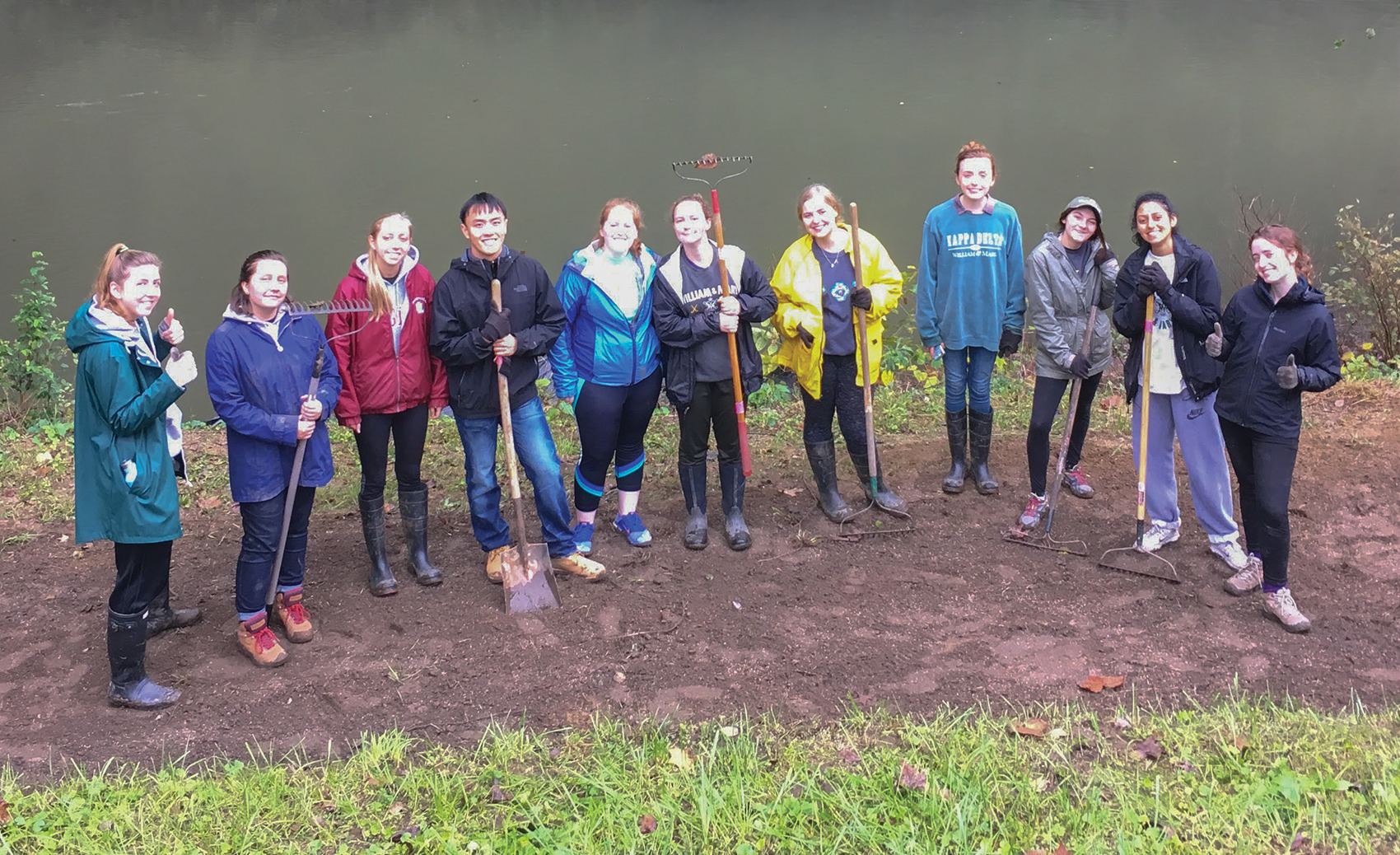
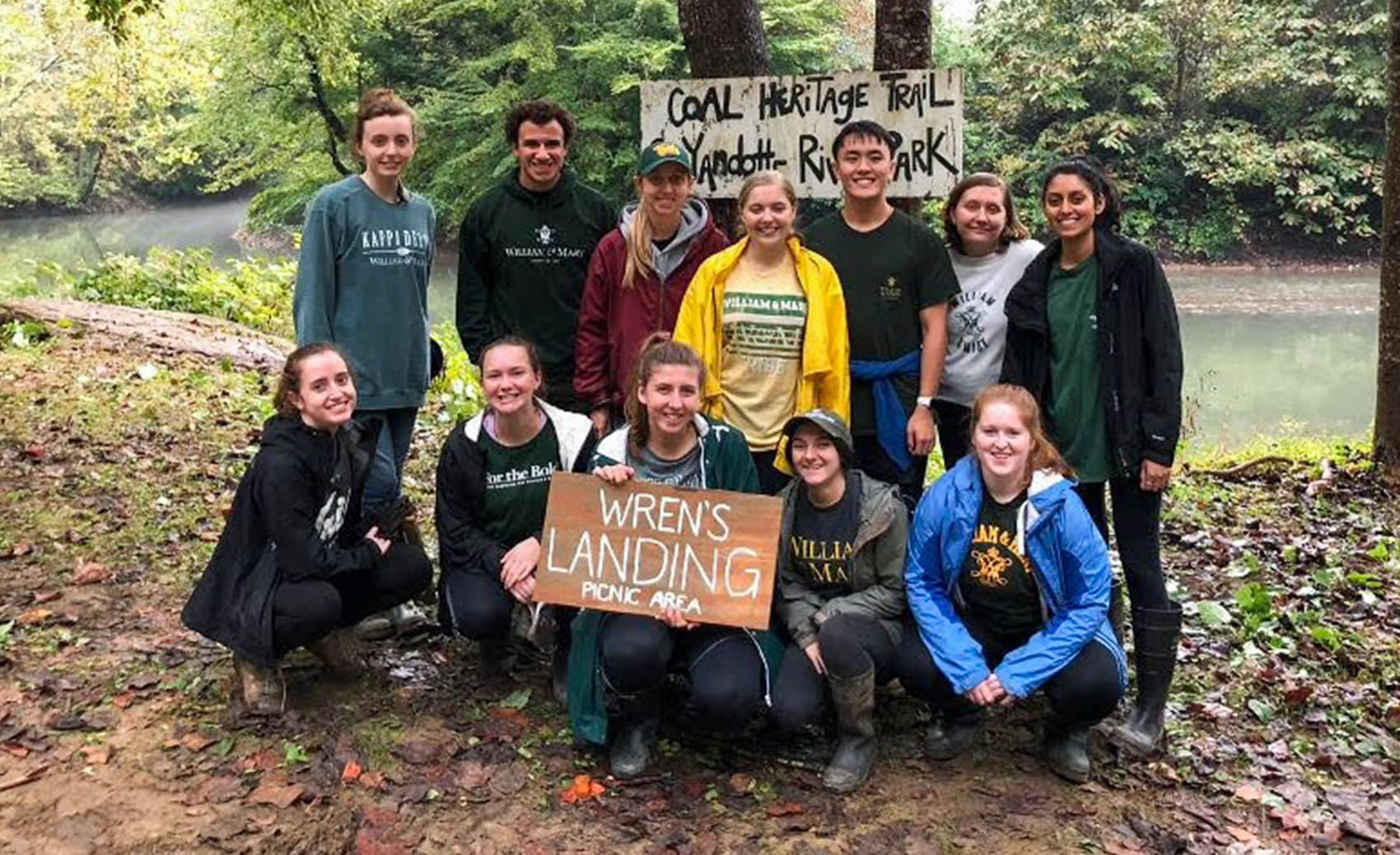
Before classes started his freshman year, Alex Vanik ’21 participated in a program called 7 Generations that introduced incoming students to civic engagement and volunteer opportunities in Williamsburg.
“We got to go to the city hall and learn our way around the community,” he says. “That set a strong foundation for me to stay active in the community throughout college.”
For the next couple of years, he returned to lead 7 Generations and he joined Aim 4, now known as the W&M Civic Leadership Program. Through that, he connected with other students who wanted to make a difference in the community. He recalls meeting with elected officials and being invited to dinner at a city council member’s home.
Vanik, an international relations major, also became a leader in the Branch Out Alternative Breaks program, which included a service trip to Mullens, West Virginia. There, he witnessed effects of rural poverty that he had not seen growing up in Northern Virginia — and he learned how to line dance. He worked alongside volunteers with AmeriCorps, an organization he later joined himself with encouragement from mentor Elizabeth Miller ’11, M.Ed. ’18, associate director of civic & community engagement at W&M.
Vanik says these experiences helped prepare him to communicate effectively with a wide range of people — a skill he relies on for his current job as a program development officer with Serve Virginia, a state agency that coordinates community service and volunteer work.
“It’s important to approach any community you’re working with as an active listener and with dignity for the people who live life differently than you do,” he says. “That’s really the heart of civic engagement, just getting out and doing things in your community to improve it alongside other people, regardless of what your differences in opinion or lifestyle might be.”
Hannah Wolfe ’26, who participated in the Civic Leadership Program in 2024, received the President’s Award for Service to the Community last summer in recognition of her leadership as a literacy tutor at The Arc of Greater Williamsburg, a nonprofit that serves adults with intellectual and developmental disabilities. A neuroscience major from Suffolk, Virginia, Wolfe serves as a resident assistant and vice president of philanthropy and community service for the Panhellenic Council at William & Mary.
Although she first learned about The Arc through her sorority, Pi Beta Phi, Wolfe says being around other students in the Civic Leadership Program inspired her toward greater involvement.
“I was working with 15 students who were completely mind-blowing to me in the way they listened to communities and worked with people,” she says. “Hearing from their experiences and being in that environment led me to become more community driven.”
To increase students’ interest in community engagement, William & Mary recently introduced a Civic Action Scorecard that allows students to earn points and recognition for activities such as attending a court hearing or government meeting, going to a worship service of a faith other than their own or participating in a sustainability workshop.
Starting this fall, students who want to explore democratic principles, civic engagement and community life in a residential setting will have an opportunity to join the new Democracy Scholars Living Learning Community. The new community for first-year students is inspired by the legacy of the 1970s-era Project Plus program and supported by alumni. It is designed to create a foundation for leadership and civic involvement.
SPEAKING OUT
William & Mary’s numerous student organizations provide myriad opportunities to gain civic engagement experience. Some students, like Olivia Keller ’28, are also creating their own leadership roles.
In the past, Keller tended to keep quiet about her conservative Christian beliefs at William & Mary, where liberal students outnumber conservatives. That changed after the fatal shooting of conservative activist Charlie Kirk while he was speaking to students at a Utah university on Sept. 10.
“That was a huge moment in society, because it was an act of political violence, and I personally don’t think that’s acceptable on either political side,” says Keller, a marketing major from Virginia Beach and president of William & Mary’s recently revived chapter of Turning Point USA, the organization Kirk founded in 2012.
“I think that people should be listening to both sides and forming their own opinions, rather than being given one way to think,” she says.
Grace Carryer ’27, who participated in the protest outside of the Turning Point USA meeting, told The Flat Hat that protesters brought signs showing quotes from Kirk that they see as offensive to some groups on campus.
“We’re trying to meet students with the ideology that they’re perpetuating and make sure that they understand what being a part of the club means to other students here,” she said.
Keller says she wants to help foster an environment in which people who share her views feel safe speaking out. “I hope to have a more tolerant, open campus,” she says. “I hope for people to be able to openly discuss their beliefs without being harassed.”
TOOLS FOR ENGAGEMENT
An October national survey of more than 2,000 undergraduate students by the Foundation for Individual Rights and Expression (FIRE) and College Pulse, a student-centered survey company, sought to assess the climate for free speech in the aftermath of Charlie Kirk’s death. The survey found that students across the board felt less comfortable expressing controversial views, attending public events and engaging in open discussion, both online and in person.
The survey also found a widening gap in tolerance of controversial speakers, with moderate and conservative students pulling back from speaker bans, while liberal students are becoming more inclined to exclude speakers whose views they find harmful or offensive. Overall, 68% of students in the survey said shouting down a speaker is an acceptable protest tactic, and 32% said using violence to stop a campus speech is acceptable.
In 2021, a student group at William & Mary sought to block a religious liberties lawyer from speaking at W&M Law School, arguing that the organization he represents had lobbied against same-sex marriage and hate crime protections for people who identify as LGBTQ+. Law School Dean A. Benjamin Spencer refused to disinvite the speaker.
“That’s not what you do at a university,” Spencer told the group. “It’s the job of a university to bring in a range of views, and your remedy is to go to the event and not disrupt it but ask questions — they can be challenging questions — and engage in that dialogue, not suppress the speech.”
Each fall, the dean now includes a similar message to first-year law students. In addition, the Law School held a seminar for first-year law students in September, titled “Citizen Lawyers: Civil Discourse and Difficult Decisions.” The program is based on a national initiative by federal courts that is designed to improve decision-making and civil discourse skills.
The Law School’s Institute of the Bill of Rights Law hosts the Scalia-Ginsburg Collegiality Speaker Series, launched in 2022 to encourage friendship in a time of increasing partisan division. The series brings together pairs of advocates, judges and legal scholars who share a warm friendship despite disagreements over how they see the law. The February 2025 event featured Paul Clement, solicitor general under former President George W. Bush, and Donald Verrilli, solicitor general under former President Barack Obama.
Spencer says civil discourse is critical to W&M’s proud tradition of educating citizen lawyers who become leaders in their communities. The Law School also provides practical experience for students who provide pro bono services to local residents through clinics that focus on veterans’ benefits, special education, immigration, tax preparation, housing and other needs.
“It’s important to give people the tools for appropriate engagement that leads to shedding light on a topic and deepening understanding,” Spencer says. “And that’s what we’re trying to promote.”
In 2025, the Law School invited SpaceX Senior Vice President Timothy Hughes J.D. ’97 to speak at Commencement. Some students were displeased, given the company’s association with founder Elon Musk, who had been the face of federal government cost-cutting efforts during the first few months of the year. But this time, there were no calls to cancel the speech, Spencer says.
“They requested to meet with the speaker and he had a meeting with students who wanted to talk about those issues,” the dean says. “They handled it very constructively.”
PROTECTING FREE SPEECH
Abby Varricchio ’23, a first-year law student at Drexel University Thomas R. Kline School of Law and former development associate at FIRE, says her experience at William & Mary researching issues related to free speech set her on her career path. She hopes to eventually practice First Amendment or media law.
Varricchio recalls that during her sophomore year at W&M there was intense debate surrounding abortion rights and restrictions. Students from opposing groups were erasing each other’s messages from a community chalkboard outside the Integrated Science Center.
“It caught me by surprise,” she says. “I wanted to know what drove students’ reactions and how the administration could help students achieve good political debate.”
At the time, Varricchio was involved in the Civic Agency Project, which applied multidisciplinary approaches to civic engagement. She worked with John Lombardini, an associate professor of government, and Anne Humphries Arseneau ’89, M.A.Ed. ’92 in Student Leadership Development to create and circulate a survey gauging students’ attitudes about the university’s policies concerning free expression. Later, W&M’s administration updated and clarified policies related to posting chalkboard messages and flyers.
She talked about her experiences this past November as a guest speaker for the university’s new chapter of BridgeUSA, an organization whose mission is “to empower young people to engage in constructive dialogue and disagreement to improve the quality of politics.”
At the meeting, students asked about FIRE’s free speech rankings, in which William & Mary received an overall rank of 33 out of 257 colleges and universities. The survey description notes that the university’s strongest asset is its “green light” Spotlight rating, which rewards clear, speech-protective written policies. However, survey results show 45% of responding students had self-censored at least once or twice in the past month. According to the survey overview, the results suggest “persistent skepticism about how free expression plays out in practice.”
Varricchio points out that William & Mary’s rank of 33 puts the university just under the top 10% of U.S. institutions of higher learning.
“I took great pride in telling students that the administration has given us the tools and now students — especially the students in this room — can have those hard conversations openly,” she says. “We should be emboldened by that.”
BRIDGING DIVIDES
Independent of each other, both Emma Fix ’26 and Ylva Oppold ’26 sent inquiries last spring to BridgeUSA about starting a chapter on campus.
“I realized there needed to be a space where people could share their views,” says Fix, a history major from Norfolk, Virginia. “BridgeUSA is not a debate club, it’s just a place where you can hear other people’s opinions. The point of the club is also to find solutions that work for everybody, and that can only be done if you hear everybody out.”
After an interest meeting in October, the group held its first gathering as a recognized student organization on Nov. 18. In an effort to invite diverse perspectives, Oppold reached out to all the political organizations on campus for the second meeting, just before Thanksgiving break.
On the day the meeting took place, the first person to walk in was someone who had learned about the event through the new Turning Point USA chapter on campus.
The topic for that evening was handling of the Epstein files.
“In the end, it was a really good discussion, and almost everyone in the room was agreeing with each other,” says Oppold, an international relations and philosophy student from London. “I thought, ‘OK, this is the point.’”
HEALTHY DEBATES
Len Neighbors, faculty advisor for the W&M Debate Society and teaching professor of speech, sees the current generation of college students as more reticent than their predecessors to disagree in public.
“They’ve watched the adults in their lives lose the ability to have civil disagreement,” he says. But when he gives students permission to argue in debate classes, they embrace the opportunity.
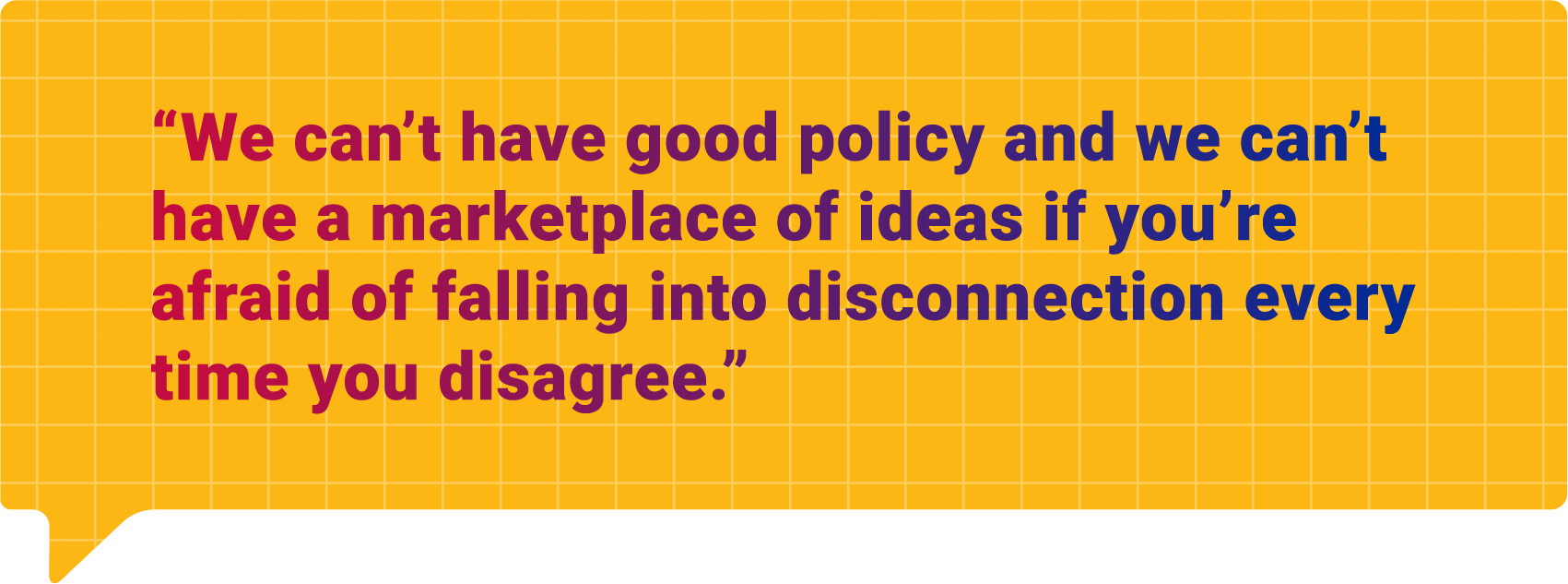
“They instinctively know that you have to be able to do this to run a civilization,” he says. “We can’t have good policy and we can’t have a marketplace of ideas if you’re afraid of falling into disconnection every time you disagree.”
At Debate Society events, disagreement is an inherent part of the structure. Similar to a competitive sport, participants face off over ideas and then shake hands afterward. They also need to be prepared to argue either side of an issue, providing insight into how someone might reach a different opinion than your own.
For example, Neighbors says, “If I strongly believe that the border of the United States should be open and my opponent takes that position because they’re first to speak, I have to take a different position.”
Seeing an issue from the opposing viewpoint can be instructive, he says: “My fundamental belief is that you will never be an effective advocate of your own position until you’ve had to oppose it.”
Examining an issue from all sides often leads to an improved outcome, he adds: “The bedrock principle that two advocates strongly defending their positions will produce a better idea, a better compromise, a better solution — that is the foundational principle of the debate that we do.”
Neighbors traces the society’s roots back more than two centuries at William & Mary, where the nation’s original chapter of Phi Beta Kappa hosted public debates. Today, students meet twice weekly on campus and travel to tournaments with other universities. The society consistently ranks among the top universities in competition nationwide.
Last spring, two W&M Debate Society members demonstrated their skills for members of the university community by debating the question “Is College Worth It?”
Joann Yu ’28, a chemistry and economics major who participated in that debate as a freshman, is now president of the society. Yu enjoys the competitive aspect of debates, but just as important is the opportunity to make friends at William & Mary and other universities. In the previous academic year, she was among the top 10 individual competitors in the American Parliamentary Debate Association. At last spring’s debate, she was given the task of arguing that college is not worth the investment.
“I would say that I probably had the more difficult side, so this is a good example of how it’s not really about what I personally believe in, it’s just what arguments are available,” Yu says. Her arguments focused on cost versus return, the applicability of skills learned and the effects of artificial intelligence on higher education.
“The audience was pretty receptive,” she says. “They laughed at the bits that were funny, and they had great questions at the end.”
DISAGREEING RESPECTFULLY
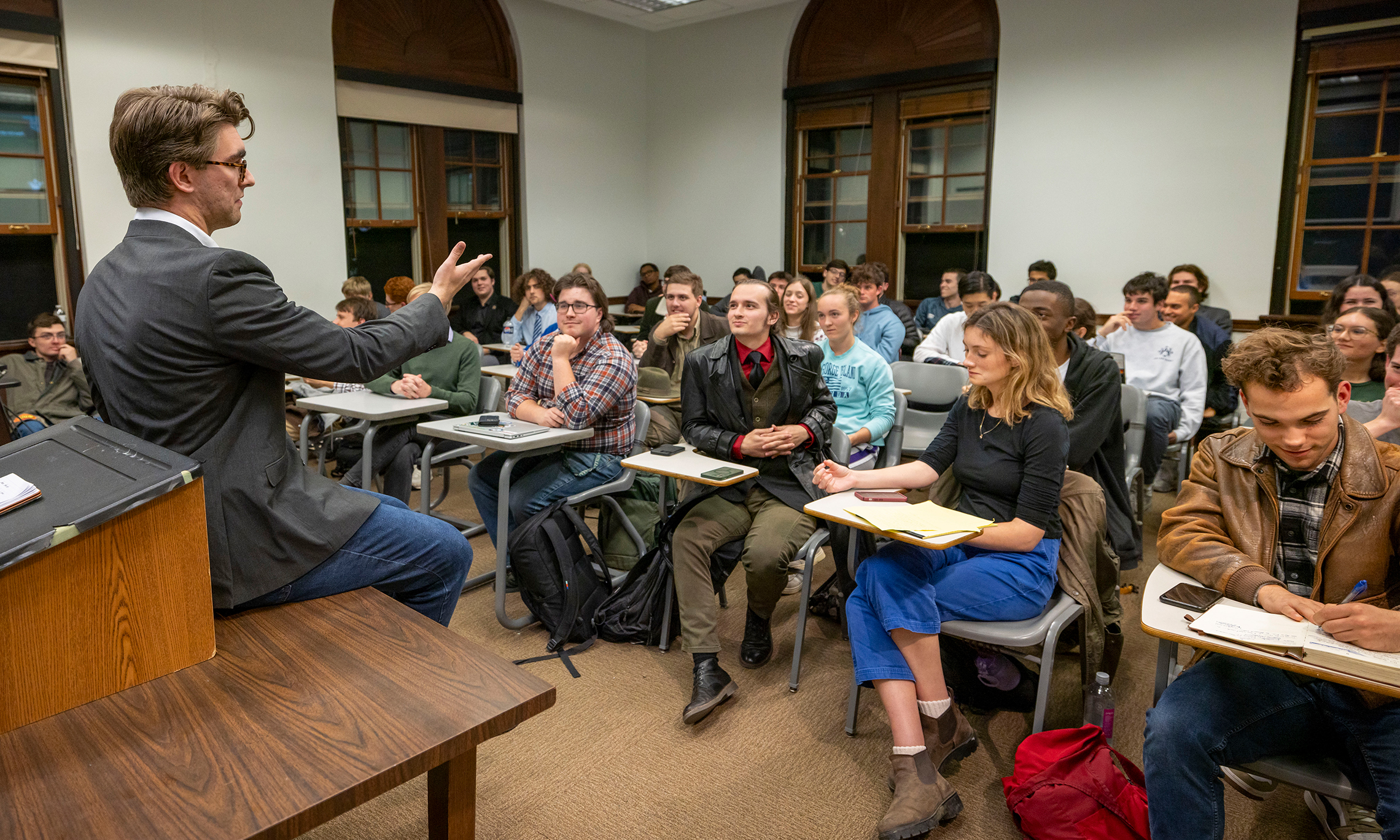
On Oct. 27, the seats in Room 201 at Blair Hall filled up quickly for a joint debate hosted by W&M Young Independents in collaboration with College Republicans and the Liberal Students League. Additional chairs were added as about 75 students squeezed in. The evening’s topic: “What should be done about political violence in America?”
After a coin flip determined the first speaker, students from each group took turns at the podium, with speakers given three minutes each to make their case, followed by an opportunity for questions and answers.
Despite clear differences of opinion about how to address the problem, students listened to the speakers without interrupting and they applauded each one. Usually, the last part of an event hosted by Young Independents is dedicated to reaching a resolution that the majority of attendees agree on. This time, that didn’t happen because of the large number of participants.
“Strong attendance and passionate speakers bode well for more events like this in the future,” says Arman H. Manternach ’27, an international relations and finance major from Oregon and president of W&M Young Independents. “We’ve already been working on a larger and more publicly visible event for the spring semester.”
Afterward, clusters of students remained in the room, engaged in conversation.
“At events like these, I don’t think people come to have their minds changed,” says College Republicans Vice President Caleb Ruger ’27, a government major from Northern Virginia. “In some ways that’s unfortunate, but really this is an arena for people to pit their ideas against other people’s ideas.”
Young Independents Vice President Hunter Steele White ’27, a government and religious studies major from Arizona, says interest in the debate is a sign that civil discourse is alive and well at William & Mary.
“At a time when people are so worried about not allowing ourselves to engage in the marketplace of ideas, events like this are what it’s all about,” he says. “It’s about engaging in a free exercise of thought, of debate, of argument.”
Liberal Students League member Cameron Swartz ’28, a government student from Florida, says he believes political participation in events like the debate can help resolve America’s polarization: “It makes people realize they’re not as different as they might assume they are.”