The Will to Make a Difference
Will Payne ’01 is redefining clean-energy innovation and entrepreneurship in Southwest Virginia
January 28, 2026
By
Jeremy Norman
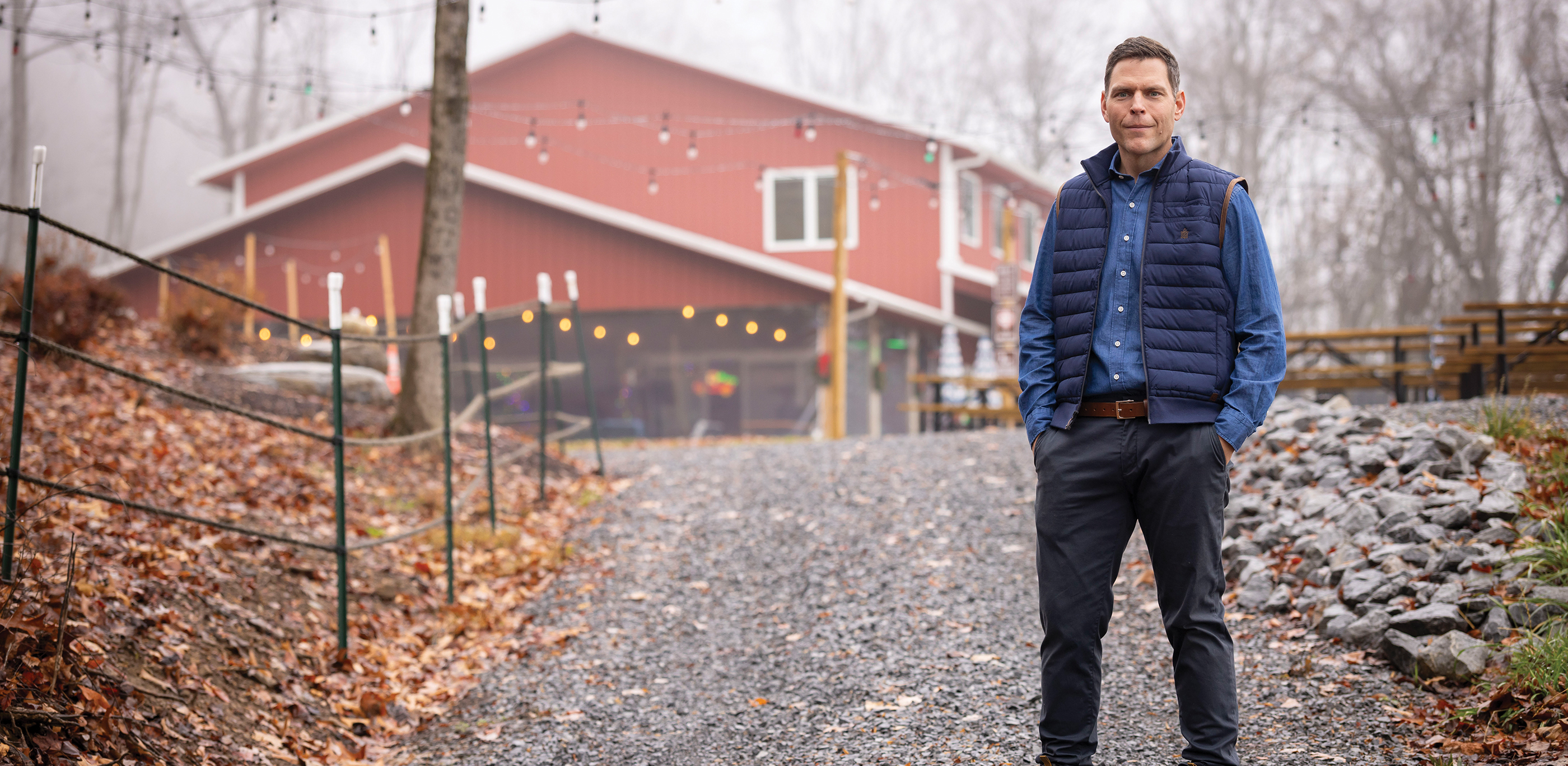
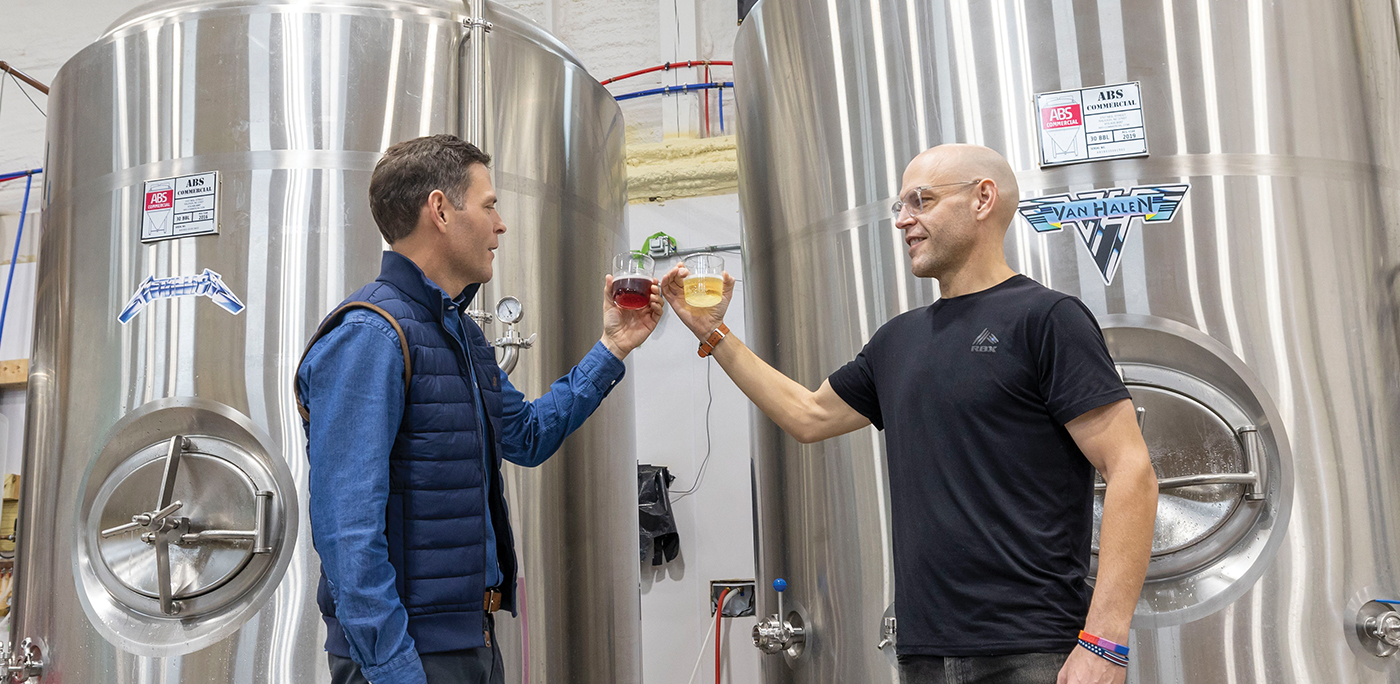
From the firepits at Squabble State Hard Cider & Spirits in Bristol, Virginia, you can see multiple layers of the southern Appalachian Mountains stretching into Virginia, Tennessee and North Carolina. The views are sweeping, the air is crisp and the cider flows cold from vats named after metal bands — Metallica, Van Halen, Def Leppard, Guns N’ Roses, Dokken and Mötley Crüe.
There is no place Will Payne ’01 would rather be.
Squabble State reflects the two constants that have defined his career — a drive to build things that matter and an unwavering belief in the potential of people. That same instinct to invest in people also shapes his service to William & Mary, where he has held key leadership roles on the university’s boards, supported major initiatives and created the Clean Energy Initiative Endowment to fuel student innovation.
The 68-acre agritourism destination he co-founded features a hard cider production facility, apple orchard, event spaces and ongoing projects including a distillery, cabins and trails. It may appear to be a rural escape, but for Payne, Squabble State is more than a business. It is an act of commitment, a form of stewardship and a tangible investment in the region he has spent years helping to rebuild.
“Southwest Virginia is my home,” he says. “Squabble State is where I stay grounded and where my creativity flows.”
Payne’s path to cidermaker and regional economic developer was unconventional. It runs through William & Mary, the highest levels of Virginia politics, complex large-scale energy development, multistate economic partnerships and, unexpectedly, coaching hockey in Vermont. But like the Revolutionary War-era explorers whose disputed land inspired the cidery’s name, Payne has always been drawn to the frontier — places, ideas and opportunities waiting to be charted by someone willing to do the work.
As he puts it, “I’m driven by the thrill of creating something, whether it is political, entrepreneurial or this cidery, where I’ve helped build the facility and infrastructure with my own two hands.”
Finding His Sextant at William & Mary
Payne, who grew up in Richmond, Virginia, applied to William & Mary without ever making a formal campus visit. With support from both of his parents, he chose the university for its reputation and fit. His family emphasized ambition with responsibility, and he carried that mindset to campus alongside his twin brother, Jud Payne ’01. At William & Mary, he found not only rigorous academic programs but also a culture of civic engagement.
“I grew up hearing that giving back was part of the deal,” he says. “I started volunteering in middle school, and William & Mary helped me turn that instinct into a habit.”
He arrived in Williamsburg as a promising student still finding his lane. “I could hold my own in the classroom, but it took me a while to discover what I wanted to pursue,” he says. While at William & Mary, his political sensibilities and entrepreneurial ambition found their footing.
As a student, Payne played goalie for the university’s club ice hockey team and coached youth hockey on weekends. He committed himself to community service and immersed himself in public policy courses that encouraged him to examine the principles behind civic responsibility.
Most importantly, the university taught him two lasting lessons, he says. “Everything I have been able to build in my career traces back to two things William & Mary forged in me: an interdisciplinary way of thinking and the confidence to act on big, unconventional ideas.”
From Hockey Rinks to Campaign War Rooms
After graduating from W&M, Payne did not immediately enter politics. Rather, he followed his father’s advice to try something unexpected and took a position at a Vermont prep school, teaching and coaching hockey. He still describes it as one of the best jobs he ever had, rivaled only by driving the Zamboni for SkateNation, home of the Richmond Renegades.
Two years later, politics pulled him back to Virginia.
His first experience had been for a W&M student project conducting exit polling on Election Day in 2000, followed by working for then-Lt. Gov. John Hager’s unsuccessful campaign for governor in 2001. Something about translating data into strategy captured his interest: By 2003, he was working on political campaigns full-time.
“In politics, you are selling a person or an idea. Campaigns are results driven. You are basically told to make it happen, or you are fired,” he says with a laugh.
The high-pressure environment suited Payne. He built relationships across the state, relationships he continues to draw on in his work today. As someone who has worked with both Republican and Democratic leaders, he resisted being sorted into a camp.
“My job was never about serving a party,” Payne says. “I was hired to build a coalition.”
He worked closely with U.S. Sen. Mark Warner, a former Virginia governor, on his successful 2008 Senate campaign. Payne later wrote “Mark Warner the Dealmaker,” a biography tracing Warner’s rise from Nextel co-founder to governor.
“I’ve always known Will to be practical and purpose driven,” Warner says. “He approaches complex challenges with a deep respect for people and place and with the goal of getting the best results possible.”
Warner continues, “It’s this pragmatic mindset that has allowed him to work with both Democrats and Republicans. Will has been especially effective in regions like Southwest Virginia — where trust is earned, not given — because he’s willing to work with anyone and has the patience and practicality to do so.”
One commitment Warner made on the campaign trail resonated with Payne: No part of Virginia would be left behind. Payne carried that promise forward in his own work. “I have always been drawn to leaders who represent the best of Virginia,” he says. “I have been fortunate to work with people I believe in.”
After 15 campaigns spanning nearly two decades, Payne began looking for a lane beyond politics. Joining Gov. Ralph Northam’s administration in early 2018 to work on offshore wind and energy strategy was formative for him, but it also underscored the constraints of public systems. He came to see government as essential for direction and guardrails, while the private sector could mobilize capital and partnerships faster. He left after 18 months to pursue work outside government.
The state government experience, however, was transformative. It introduced him to the challenges facing the coal-field communities of Southwest Virginia, and Payne came to believe that the region could be reimagined.
Redefining What’s Possible in Southwest Virginia
Payne arrived in Southwest Virginia in mid 2019 with a campaign strategist’s eye: The assets were there, but the story and the alignment weren’t. “I could see how to build a coalition and deliver,” he says. The region, with its rugged geography and resilient people, sparked something in him.
He saw not decline, but opportunity.
Southwest Virginia has long faced significant economic challenges. Wages trail state and national averages by roughly a third, poverty rates are substantially higher, job growth has lagged and years of emigration have hollowed out the workforce.
The data reflects this reality. Poverty levels in the region are nearly twice the statewide average, large numbers of adults are out of work and the area suffers from persistent income stagnation. These conditions are rooted in the decline of the coal industry and the region’s slow shift toward a more diversified economy.
“My goal is to grow the economy so more people have a real shot to succeed,” he says. “To me, success is building projects that create durable local tax revenues, the kind that can replace what communities lose when legacy employers leave or shrink.”
He saw undervalued assets — community colleges working in sync, strong infrastructure, a workforce eager for good jobs and landscapes filled with possibility. He also saw how outdated perceptions limited the region’s potential, along with a persistent lack of long-term, community-focused investment.
Payne began reshaping the story through Coalfield Strategies, the economic development firm he founded to translate Southwest Virginia’s assets into investable, job-creating projects. A flagship early effort, InvestSWVA, brought public and private partners together, packaging the region’s sites, workforce and infrastructure in a way that made it easier for prospects to say yes and faster for communities to respond.
But for Payne, changing perception wasn’t a slogan. It required showing up, doing the legwork and building a pipeline of wins.
He embedded himself in the community, approaching the work with the strategic mindset of a campaign manager. He knocked on doors, built trust, gathered data, mapped assets and connected stakeholders.
“Will came into Southwest Virginia from outside the area and immediately fit in, with no prior judgment of the region but a strong desire to contribute,” says Mike Quillen, chair of Energy DELTA Lab and former rector of the Virginia Tech Board of Visitors. “He has learned the history and successes of the region, especially in the energy arena.”
Payne flipped “here is how you can help the region” to “here is how the region can solve your problem better than anywhere else.”
Quick wins were essential. They came in the form of several hundred new jobs in technology, health care and energy, including projects with higher retention and satisfaction rates than comparable operations elsewhere.
Those early victories showed where the region could compete at scale. Payne saw the biggest, most enduring opportunities in clean energy. Now with Energy DELTA Lab and the Southwest Virginia Energy R&D Authority, he and his partners are advancing projects on reclaimed coal mine lands, eyeing turning once-disturbed sites into platforms for new investment.
“Rather than calling shots or giving advice from afar, he moved to Southwest [Virginia], embedded himself in the community, and put his own capital and credibility on the line,” Warner says. “Will believes that honoring a region’s past and building its future are not opposing ideas.”
Pumped storage hydropower, solar and mine-water geothermal-cooled data centers have become practical pathways for putting land back to work and rebuilding local economies. “What better way to revitalize the region,” Payne says, “than to use the land that once powered America to power what comes next?”
The work is slow, complex and political. Patience, he notes, is the biggest challenge. Yet Payne remains steadfast. His approach is rooted in relationships, transparency and a strong belief in the people of Southwest Virginia.
“People want to build a life here,” he says. “They want businesses to invest in them. My job is to connect the right decision makers and make it easier to say yes.”
A New Chapter: Squabble State Hard Cider & Spirits
The cidery was never part of Payne’s original plan. But in the breaks between energy projects, he and his co-founder — longtime friend Will Clear — developed an idea with deep local roots.
“Farmers are the original entrepreneurs,” Payne says, noting that Southwest Virginia had once been a major grain producer. Apple culture also runs deep. Through Appalachian Grains, a pilot project that connected local growers with the craft beverage industry, he saw firsthand how much the land and its history still shape what’s possible.
So, in 2020, Payne and Clear set out to build a craft beverage company “rooted in historical defiance.” The name Squabble State comes from a centuries-long land dispute along the Virginia-North Carolina border, which later became the Virginia-Tennessee state line. Revolutionary War widows even listed the area, then called the Squabble State, as their home address. The sextant in the logo references the early surveying tool that created and eventually resolved the conflict.
“Everything about Squabble State is rooted in place,” Payne says, “built for this land, the community and the history that shaped it.”
The farm they purchased was rugged, beautiful and underutilized. Zoning was the first hurdle, and local leaders supported the project. The team planted their first apple trees in 2023, choosing varieties local to the region, all carefully tied and trained to grow upright.
“Farming teaches humility,” Payne acknowledges. “Weather, pests, disease. If it can go sideways, it will.”
The cidery opened in fall 2024. That first winter tested the young business, bringing the region’s harshest weather in decades, though fall 2025 was spectacular, according to Payne.
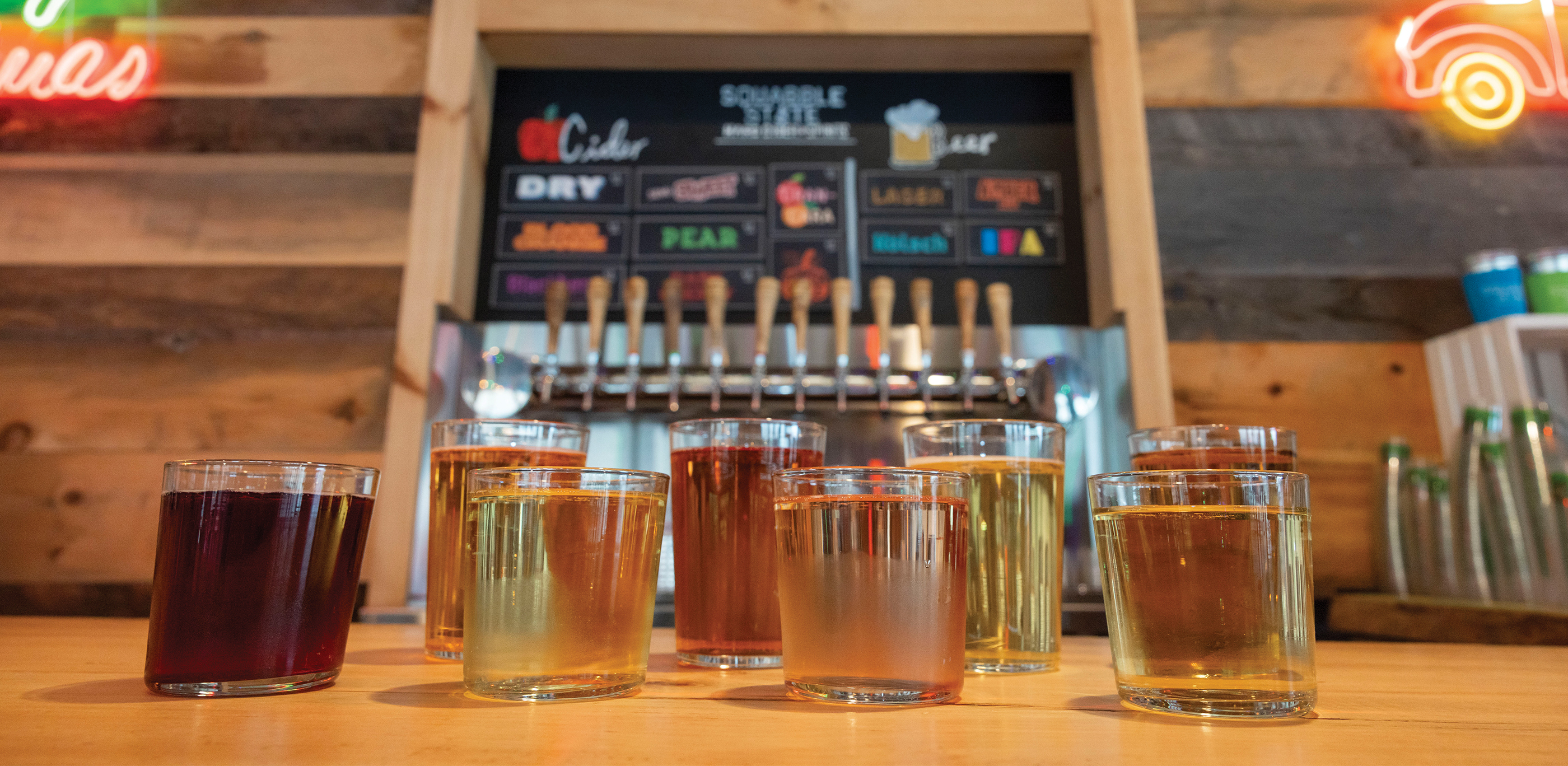
Depending on the season, Squabble State features six to eight ciders on tap or in cans. Its core lineup includes dry, semi-sweet, pear, blood orange and its most popular flavor, blackberry, alongside rotating seasonal offerings such as pumpkin spice, gingerbread, blueberry lemon, bourbon barrel-aged vanilla, strawberry and dark cherry. The tap list also includes beer, with options such as a lager, a Kölsch, an amber ale and an IPA.
The ingredients are intentionally simple, free of artificial flavors or extracts. “It’s fermented apple juice, lightly back sweetened with organic sugar and sometimes blended with other fruit juices,” Payne says. “Nothing pretentious, just a crisp, dry-style cider for everyday drinkers.”
Today, Squabble State has become a regional destination for families, hikers, cider lovers and visitors from Tennessee, who make up more than half its customer base. The space expands each season. The orchard and cidery came first, to be followed this year by a 6,000-square-foot distillery and wedding venue. Cabins and nature trails are on the horizon.
For Payne, the philosophy is simple. “Give people more than a reason to stop. Give them a reason to come back. That’s how you become a destination.”
He and his business partner run much of the operation themselves and learn as they go. Payne’s twin brother, Jud, left a lucrative career at Deloitte to join the team, helping lead growth strategy and marketing while also working alongside them on energy projects. The cider vats carry the names of rock bands because Will is an avid fan of 1980s music, specifically “hair metal.” Since 2000, he has attended 242 concerts, with Def Leppard as his favorite. He is taking electric bass lessons and hopes to eventually become good enough to join a cover band that could play at Squabble State, among other venues.
He jokes that cidermaking is mostly cleaning and maintenance: “If you’re not spending most of your time sanitizing equipment and keeping it operational, you’re doing it wrong.” The resident cidery cat, Pepper, supervises from underfoot.
Squabble State also carries strong W&M ties. Students helped to design the business space and research the area’s history using the diaries of famed explorer Thomas Walker, who attended William & Mary in the 1700s and was the first person to explore the Western Colony of Virginia, now present-day Kentucky. Troy Wiipongwii M.P.P. ’18 of the Institute for Integrative Conservation has advised on sustainability models and indigenous crop opportunities. Daron Ford M.B.A. ’24, a 20-year fermentation science expert, serves as a business consultant.
“This isn’t a pitch, it’s a commitment,” Payne says of Squabble State. “We built the business without investor pressure, and we’re growing it here for the long haul.”
Giving Back: A Legacy Rooted in Service
“Will is a problem solver, a uniter and a natural servant leader,” says former W&M Rector Todd Stottlemyer ’85, D.P.S. ’25, P ’16, P ’21. “He has a wide lens due to the breadth of his experiences, which gives him the ability to see around corners, anticipate challenges and opportunities, and bring people together to chart a path forward.”
Payne’s service to William & Mary is extensive. He has served on the Board of Visitors twice, rising to vice rector and chairing key committees, including the Committee on Administration, Buildings & Grounds. Serving on the committee that oversaw the hiring of President Katherine Rowe remains a highlight.
“Will’s active participation and steady leadership throughout the presidential search process, which resulted in the hiring of Katherine Rowe, were critical to the success of the search,” Stottlemyer adds.
Payne now chairs the William & Mary Real Estate Foundation Board of Directors and serves on the William & Mary Foundation’s Board of Trustees, roles that have given him a new understanding of how the university operates.
“Will has been successful mainly because he listens,” says John Littel HON ’23, P ’22, who was chief of staff for Virginia Gov. Glenn Youngkin and former rector for the William & Mary Board of Visitors. “Most people talk more frequently than they listen, and they believe they can persuade people to agree. Will approaches things differently. He allows people the space to express themselves, and then finds common ground.”
Payne’s approach was particularly helpful several years ago during the Board of Visitors’ consideration of how historical figures are memorialized on campus.
“It was a real challenge, and it was a very emotional time period,” Littel says. “But I think we got it right, and a lot of that is because of Will’s character and his process in going through that.”
Payne’s philanthropy reflects the same instinct that drives his work in Southwest Virginia: long-term investment in people. “I grew up with a strong sense of responsibility to others,” he says. “That stayed with me.”
It is why he created the Will Payne Clean Energy Initiative Endowment in 2023 to support student-driven ventures through the William & Mary Entrepreneurship Hub. “Clean energy represents one of the most significant economic transformations of our lifetime,” he says. “If this fund helps even one student launch a venture or bring opportunity to a community that needs it, then it’s worth it.”
Payne adds that the endowment is also deeply personal. “William & Mary has been a constant in my life, and it’s the people that make it what it is,” he says. “Ultimately, this initiative is about gratitude. William & Mary invested in me, and now I want to help the next generation lead boldly, creatively and with a commitment to service.”
He has also supported the W&M Athletics Complex, contributed to the Alumni House expansion and hosted alumni events such as a recent Yule Log celebration at Squabble State — all driven by his belief in preserving William & Mary’s traditions and shared experiences for future generations.
“It’s important that, no matter where you live, you can stay connected to W&M and the common experiences that every alumnus shares,” he says. “They’re the moments you carry with you and instantly recognize in fellow alumni.”
Looking Forward: Building a Future That Lasts
Payne divides his week between two demanding worlds that couldn’t be more different. By day, he advances a portfolio of energy generation and R&D projects. Off-hours, Squabble State takes over: making cider, greeting guests, keeping equipment running, tending to the orchard and mapping what comes next.
He doesn’t need much downtime, and he rarely takes it.
“I’m not big on vacations,” he says. “If I need a reset, I’ll head out to a rock concert and come back recharged.”
He and Jud are closer than ever. “Less fighting than when we were younger,” he jokes. Working together professionally, they’ve discovered a shared passion for building something meaningful.
Looking ahead, Payne is focused on two legacies — revitalizing the economy of Southwest Virginia and supporting the next generation of William & Mary students.
He thinks about infrastructure, workforce development, long-term investment and the need for businesses that stay rather than relocate when challenges arise.
Payne thinks about students who, like him, need a spark that becomes a calling. He thinks about the cidery’s firepits and the view of mountain ridges rolling into the distance, where he feels at peace. And he thinks about what it means to build a legacy grounded in community.
“I want to see this region succeed,” he says. “I want the next generation to live, grow and thrive here. That is why I am invested in Southwest Virginia. It is why I am invested in William & Mary.”
After all, Will Payne has always believed that the future is brightest in places where people are willing to invest their time, their ideas and their hearts.
Where there is a Will, there is a way.